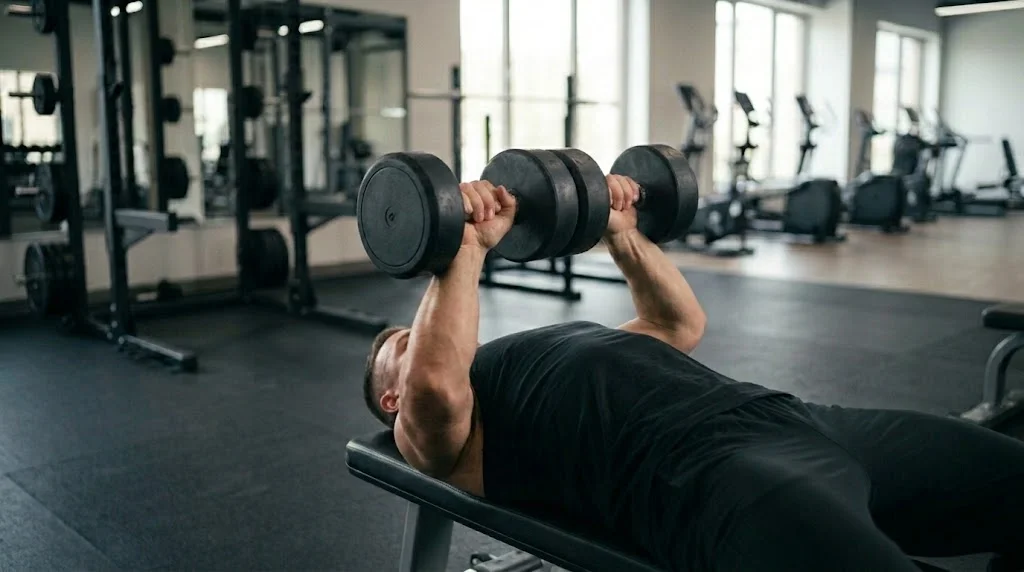
The dumbbell incline cross body triceps extension is a single-arm isolation exercise performed while lying back on an incline bench, extending the arm from behind the head diagonally across the body. The diagonal path of motion places heavy emphasis on the long head of thetriceps, which crosses the shoulder joint and responds well to an overhead extension pattern. Because it's performed one arm at a time, it also helps address strength imbalances between sides. The incline bench supports the back and removes momentum from the lower body, isolating the triceps more effectively than a standing version.
What Muscles Does This Exercise Work?
- Primary: Triceps brachii (long head)
- Secondary: Triceps brachii (lateral and medial heads)
- Tertiary: Anterior deltoid, core stabilizers (to prevent excessive arching)
How Do You Set Up for This Exercise?
Set anincline benchto roughly 45 degrees and lie back with your feet flat on the floor. Hold a single dumbbell in one hand with a neutral grip and press it to arm's length above the opposite shoulder. Brace the working arm against the bench pad or use your free hand to support the elbow, keeping the upper arm stationary throughout the set.
How Do You Perform This Exercise?
- Position the dumbbell overhead near the opposite shoulder with your elbow bent and pointing toward the ceiling
- Keep your upper arm fixed in place, using only your forearm to move through the range of motion
- Lower the dumbbell in a controlled arc down and across your body toward the outside of the opposite shoulder or chest
- Feel a stretch in the triceps at the bottom of the movement without letting the elbow flare excessively
- Extend your arm back along the same diagonal path to the starting position, squeezing the triceps at the top
- Complete all reps on one arm before switching to the other side
What Are the Key Form Cues?
- Pin the upper arm in place: All movement should come from the elbow, not the shoulder
- Keep the elbow pointed toward the ceiling: Letting it drift outward reduces triceps tension and stresses the shoulder
- Move only from the elbow: The upper arm stays fixed through the entire rep
- Control the eccentric lowering phase to maximize the stretch on the long head
- Keep your back flat against the bench pad, avoiding an arch to compensate for a heavy weight
What Are the Most Common Mistakes?
- Letting the upper arm swing forward: shifts work to the shoulders and reduces triceps isolation; keep the upper arm locked in place.
- Using too heavy a dumbbell: forces the elbow to flare and shortens the range of motion; drop the weight to keep the diagonal path clean.
- Arching the lower back off the bench: reduces stability and risks lower-back strain; keep the back flat against the pad.
- Rushing the eccentric lowering phase: loses the stretch-based stimulus on the long head; lower with control over 2-3 seconds.
- Not extending fully at the top: shortchanges the contraction; extend the arm fully each rep without locking out aggressively.
What Variations Are Worth Trying?
- Flat bench cross body triceps extension: performed lying on a flat bench, slightly altering the resistance curve
- Standing cross body triceps extension: a standing variation that increases core and stability demand
- Cable cross body triceps extension: cable resistance provides constant tension through the range of motion
- Two-arm overhead triceps extension: a bilateral version using one or two dumbbells, less isolated but allows heavier loading
- Rope pushdown: an alternate triceps isolation move that doesn't require an incline bench
How Do You Progress This Exercise?
- Increase weight in small increments once you can complete all reps with a full, controlled range of motion
- Add a 1-2 second pause at the bottom stretch position to increase difficulty
- Progress reps into the 12-15 range before increasing load significantly
- Superset with a compound pressing movement to pre-exhaust or finish off the triceps
How Should You Program This Exercise?
Place the dumbbell incline cross body triceps extension near the end of an upper-body or arm-focused session, after compound pressing movements like the bench press or overhead press. It typically works well for 10-12 reps per arm across 3 sets, with 45-60 seconds rest between sets. Perform one arm completely before switching sides to keep tension consistent.