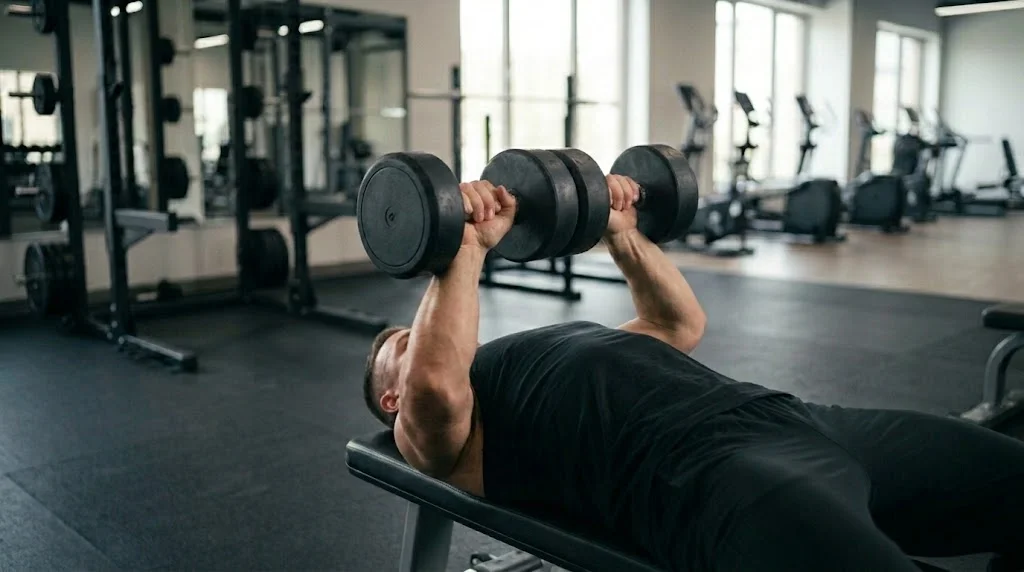
The decline bench close-grip dumbbell press is a compound press performed head-down on a decline bench with two dumbbells held together over the lower chest, loading thetricepsand lower pecs. The decline shortens the pressing path and points it toward the feet, so the lower chest and triceps take over from the front shoulder, while holding the dumbbells together keeps the elbows tucked. Compared with the flatclose grip dumbbell bench press, you can press more weight through a shorter range. Lifters program it as a second chest or triceps movement in a push session.
What Muscles Does the Decline Bench Close-Grip Dumbbell Press Work?
- Primary: Triceps brachii, pectoralis major (lower chest)
- Secondary: Anterior deltoid, pectoralis major (mid chest)
- Tertiary: Serratus anterior, biceps brachii, forearm flexors (grip)
How Do You Set Up for the Decline Bench Close-Grip Dumbbell Press?
Set the bench to a decline of 15 to 30 degrees. Sit on the pad with the dumbbells on your thighs and hook your shins under the rollers. Lie back and bring the dumbbells to the sides of the lower chest with the palms facing each other and the flat faces of the plates touching. Pull the shoulder blades together and pin them to the pad, wrists straight.
How Do You Perform the Decline Bench Close-Grip Dumbbell Press?
- Press the dumbbells to arm's length over the lower chest with the plates still touching, elbows straight but not locked hard.
- Lower the dumbbells together along a line toward the lower ribs, keeping the elbows tucked beside the torso rather than flared.
- Stop when the dumbbells touch the bottom of the chest, forearms vertical and the elbows just below the bench line.
- Squeeze the dumbbells into each other for one count at the bottom so the elbows stay in.
- Press back up and slightly toward the feet, driving the plates together until the arms are straight over the lower chest.
- Hold the top for a beat, check the shoulder blades are still pinned, and lower into the next rep.
What Are the Key Form Cues?
- Elbows brush the ribs: on the way down the upper arms slide beside the torso, never out to the sides, so the triceps do the lowering.
- Crush the plates together: the inward pressure keeps the dumbbells from separating at the top and holds the elbow tuck.
- Push the bench away with the upper back rather than reaching the shoulders toward the dumbbells.
- Drive the heels into the rollers to anchor the hips as the load moves toward your head.
- Finish each press over the lower chest, not over the face.
What Are the Most Common Mistakes?
- Loading your flat dumbbell press weight: the shorter range hides a weak bottom position and the elbows flare to compensate; start 5 to 10 pounds a hand lighter.
- Flaring the elbows out at the bottom: the load moves from the triceps to the shoulder joint, which sits exposed with the arm out and the torso tilted; keep the upper arms against the ribs.
- Letting the dumbbells drift toward the face at the top: the press becomes a flat press and the lower chest unloads; finish over the lower chest.
- Lifting the shoulders off the pad: the chest loses its base and the front shoulder does the pressing; pin the blades down before each rep.
- Sitting up too fast after the set: the head-down position pools blood in the head; set the dumbbells on the thighs and rise slowly.
What Are the Best Decline Bench Close-Grip Dumbbell Press Variations?
- Flat close grip dumbbell bench press: the same press on a flat bench, the regression with a longer range.
- Decline hex press: the plates stay crushed together on a decline for more inner chest work.
- Decline dumbbell press: standard width, palms forward, shifting the work from the triceps back to the chest.
- Single-arm decline dumbbell press: one dumbbell at a time over the sternum, a trunk stability demand.
- Decline close-grip barbell press: hands shoulder width on a bar, the same path with more load and a fixed grip.
How Do You Progress the Decline Bench Close-Grip Dumbbell Press?
- Add 5 pounds per hand once you complete all sets at 12 reps with the elbows tucked on every rep.
- Work from 8 reps up to 12 per set before moving up in weight.
- Add a set per week, from 3 up to 4.
- Slow the lowering phase to three seconds, or pause two seconds at the bottom with the plates squeezed together.
How Should You Program the Decline Bench Close-Grip Dumbbell Press?
Place the decline bench close-grip dumbbell press second or third in a chest or push session, after a flat or incline press, when the triceps are still fresh enough to lock out. Train it once or twice per week for 3 to 4 sets of 8 to 12 reps with 60 to 90 seconds of rest. Pair it with an incline fly so the upper chest is not left out of the session.