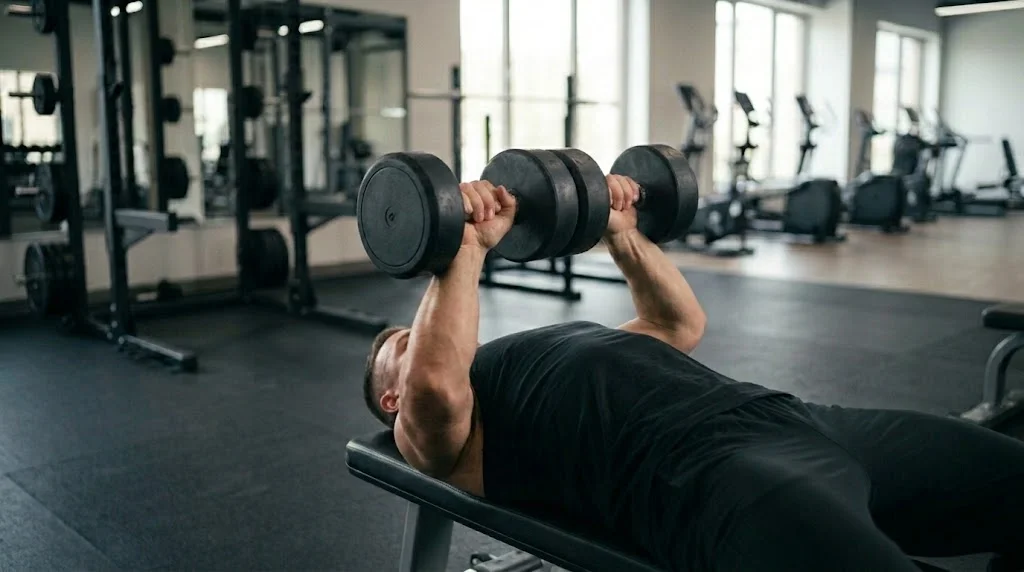
The alternating dumbbell chest press is a variation of the standard dumbbell bench press where one arm presses while the other holds a static position at the chest. This unilateral timing forces the core and shoulder stabilizers to resist rotation throughout the set, adding a stability challenge on top of the usual chest, shoulder, and triceps work. It is a useful tool for correcting side-to-side strength imbalances since each arm must complete its own full press.
What Muscles Does the Alternating Dumbbell Chest Press Work?
- Primary: Pectoralis major
- Secondary: Anterior deltoids, triceps brachii
- Tertiary: Core stabilizers (obliques, rectus abdominis), rotator cuff
How Do You Set Up for the Alternating Dumbbell Chest Press?
Lie back on a flat bench with feet planted firmly on the floor and a natural arch in your lower back. Hold a dumbbell in each hand at chest level with palms facing forward and elbows bent roughly 45-75 degrees from your torso. Press both dumbbells to full arm extension above your chest to set your starting position before beginning the alternating reps.
How Do You Perform the Alternating Dumbbell Chest Press?
- Brace your core and keep one dumbbell locked out overhead while the other stays at chest height
- Lower the resting-side dumbbell slowly to chest level, keeping the elbow tucked at roughly 45-75 degrees
- Press that dumbbell back up to full extension while the opposite dumbbell remains stationary overhead
- Immediately lower the other dumbbell to chest level, maintaining a stable torso with no side-to-side rocking
- Press it back to lockout, completing one full alternating cycle
- Continue alternating sides for the desired number of reps, keeping hips and shoulders square to the bench throughout
What Are the Key Form Cues?
- Resist rotation: Actively brace your obliques and lower back to keep your torso flat against the bench as one side loads
- Keep wrists stacked over elbows: This keeps the load path efficient and protects the shoulder joint
- Control the eccentric: Lower each dumbbell for a full 2-3 count rather than dropping it to chest level
- Drive through a full lockout: Extend the working arm completely at the top before switching sides
- Keep feet planted: Push your feet into the floor to maintain a stable base as you alternate
What Are the Most Common Mistakes?
- Rocking the torso side to side: Letting the hips or shoulders twist to help the working arm reduces core engagement and chest tension. Keep the non-working side pinned against the bench.
- Using too much weight: Excess load makes it difficult to control the static hold on the resting side, leading to shoulder strain. Choose a weight you can control on both the working and holding arm.
- Flaring the elbows to 90 degrees: This places excessive stress on the shoulder joint. Keep elbows at a moderate angle relative to the torso.
- Bouncing the dumbbells off the chest: This reduces muscle tension and increases injury risk. Lower with control and press from a dead stop.
- Losing the overhead lockout: Letting the resting arm sag while waiting reduces stability and shoulder endurance benefits. Keep it locked out and steady.
What Are the Best Alternating Dumbbell Chest Press Variations?
- Standard dumbbell bench press: Both arms press simultaneously, removing the anti-rotation demand
- Incline alternating dumbbell press: Bench set at 30-45 degrees to emphasize the upper chest
- Single-arm dumbbell floor press: Reduced range of motion that further isolates one side and limits shoulder strain
- Alternating dumbbell floor press: Performed lying on the floor, reducing shoulder range and lower back arch
- Barbell bench press: Bilateral, heavier-loading alternative once alternating pressing strength is established
How Do You Progress the Alternating Dumbbell Chest Press?
- Increase weight gradually: Add 2.5-5 pounds per dumbbell once you can complete all sets with a controlled overhead hold
- Add pause reps: Hold each rep at full extension for 1-2 seconds to increase time under tension and stability demand
- Progress bench angle: Move from flat to a slight incline to shift emphasis and add variety
- Increase reps before load: Build to 12-15 controlled reps per arm before adding significant weight
How Should You Program the Alternating Dumbbell Chest Press?
Program the alternating dumbbell chest press as a primary or secondarychest movement1-2 times per week, typically for 3-4 sets of 8-12 reps per arm. Rest 60-90 seconds between sets. Because of the added stability demand, use slightly lighterdumbbellsthan you would for a standard two-arm press, and prioritize a controlled tempo over chasing heavy weight.