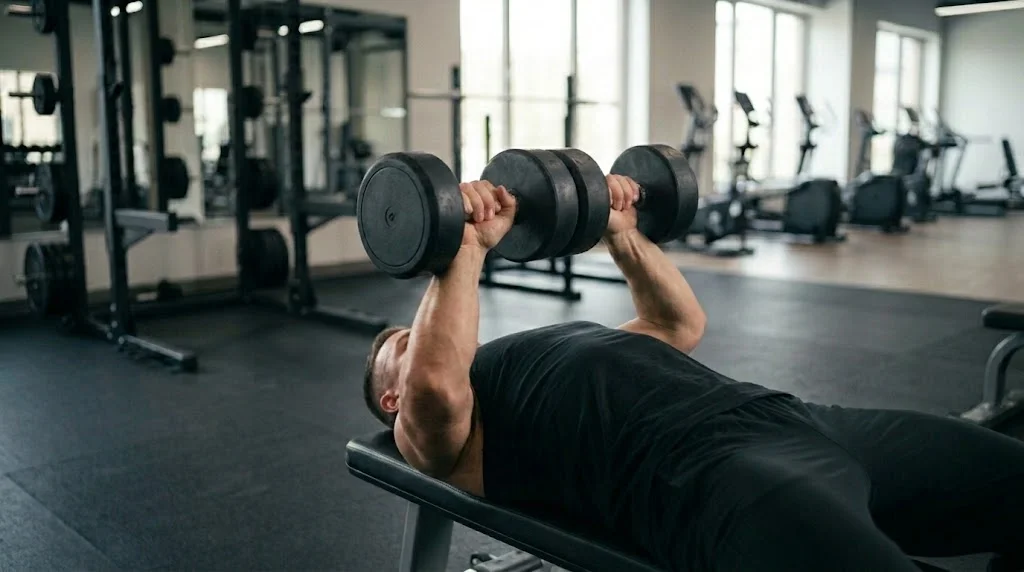
The dumbbell Tate press is a lying triceps exercise that lowers dumbbells to the chest with the elbows flared out, keeping tension on the medial and lateral heads. Powerlifters use it to build lockout strength for the bench press, since the short range mirrors the top few inches of a heavy press. It looks awkward the first time, and the load has to stay light while the elbows learn the path.
What Muscles Does the Dumbbell Tate Press Work?
- Primary: triceps brachii (lateral and medial heads)
- Secondary: anconeus, anterior deltoids
- Tertiary: pectoralis major, forearm flexors, abs
How Do You Set Up for the Dumbbell Tate Press?
Lie on aflat benchwith a dumbbell in each hand pressed over your chest, palms facing forward and the dumbbells touching. Plant your feet, set the shoulder blades back and down, and pull your ribs toward your hips. Point the elbows out to the sides rather than tucking them. Start with a pair you would curl, not press.
How Do You Perform the Dumbbell Tate Press?
- Press the dumbbells together over your chest with the palms forward and the arms straight.
- Bend the elbows out to the sides and lower the dumbbells toward the middle of your chest.
- Keep the dumbbells in contact as they travel down in a straight line.
- Stop when the dumbbells touch your chest with the elbows wide and the forearms flat.
- Extend the elbows and press the dumbbells back up along the same path.
- Squeeze thetricepsat the top, then start the next rep.
What Are the Key Form Cues?
- Keep the dumbbells pressed together: the inward pressure is what holds the path steady through the rep.
- Let the elbows flare: this is the one triceps movement where a wide elbow is the correct position.
- Move only at the elbow, keeping the upper arms roughly vertical.
- Lower slowly, since the dumbbells drift apart the moment control slips.
- Keep the wrists straight so the load stays stacked over the forearms.
What Are the Most Common Mistakes?
- Loading it like a press: the leverage is poor, so a bench press weight makes the movement impossible to control.
- Letting the dumbbells separate: once they drift apart, the shoulders take over and the whole bar path collapses.
- Turning it into a skullcrusher: dropping the elbows back behind you changes the exercise and the muscles it loads.
- Bouncing off the chest: a rebound at the bottom skips the hardest inches of the press and jars the elbows.
- Rushing the descent: control is the whole point of a short-range movement, so lower under tension for two counts.
What Are the Best Dumbbell Tate Press Variations?
- Close-grip bench press: the heavy compound version of the same lockout pattern.
- Lying dumbbell extension: elbows tucked and pointing up, which loads the long head instead.
- Floor press: pressing from the floor limits the range for the same lockout focus.
- Band pushdown: a light, joint-friendly option for high reps.
- Single-arm Tate press: one dumbbell at a time, which exposes the weaker arm.
How Do You Progress the Dumbbell Tate Press?
- Add 2 to 5 pounds a hand only when the dumbbells stay together for every rep.
- Work in the 8 to 12 rep range, since the range of motion is short.
- Add a one-second pause on the chest before pressing back up.
- Add a set rather than weight when the elbows start to ache.
How Should You Program the Dumbbell Tate Press?
Use the dumbbell Tate press after your main press, for 3 sets of 8 to 12 reps with 60 seconds of rest. Once or twice a week is enough, especially inside a bench press block where lockout strength is the target. It pairs well with an overhead extension, which loads the long head this movement deliberately leaves out.