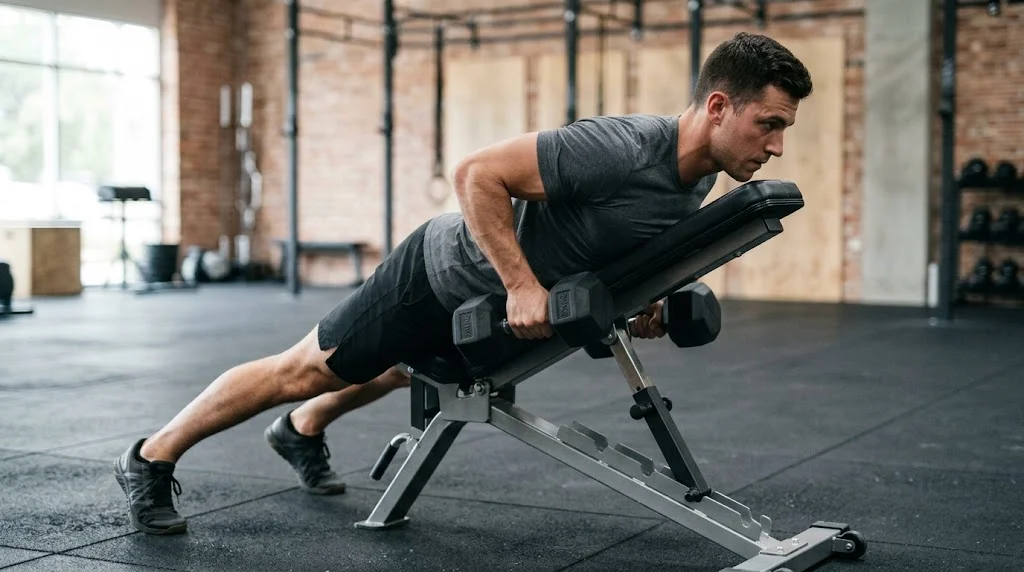
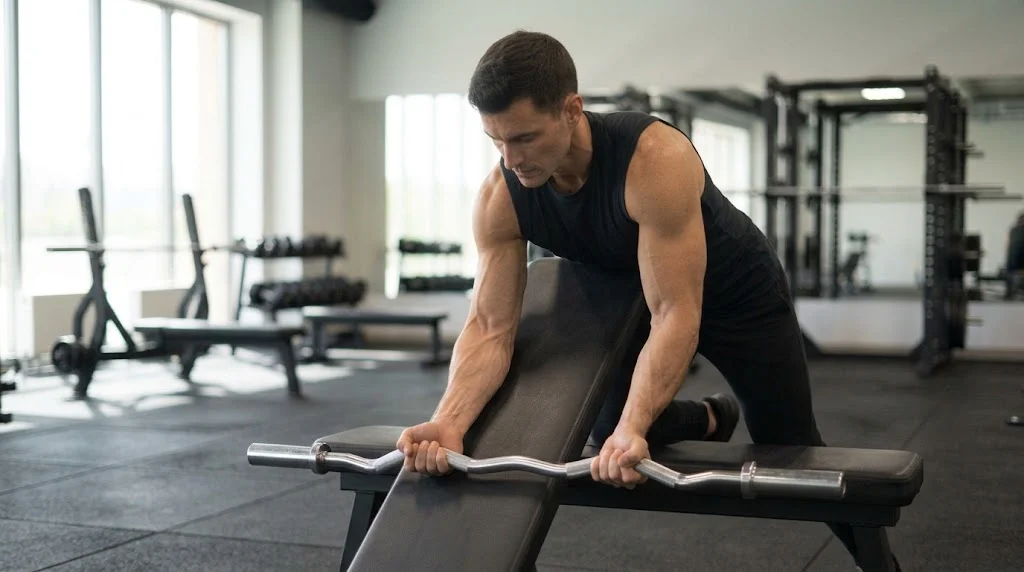
The seated incline dumbbell inner biceps curl is an isolation exercise done on a steep incline bench with a narrow supinated curl that biases the short head of thebiceps, the inner part of the muscle nearest the ribs. The bench sits high, near sixty degrees, so the upper arms hang beside or slightly in front of the torso rather than behind it, which shortens the long head and leaves the inner head to finish the rep. The back pad kills all body swing. Lifters use it as a finisher in an arm session.
What Muscles Does the Seated Incline Dumbbell Inner Biceps Curl Work?
- Primary: Biceps brachii (short head, inner biceps)
- Secondary: Brachialis, brachioradialis (forearm)
- Tertiary: Anterior deltoid, wrist flexors, upper trapezius
How Do You Set Up for the Seated Incline Dumbbell Inner Biceps Curl?
Set an incline bench near sixty degrees and pick a dumbbell for each hand. Sit back with your spine flat on the pad, your head resting on it and both feet planted. Let the arms hang straight down close to your sides with the palms turned forward and the elbows just in front of your ribs. Pull the shoulders down and back into the pad and take the slack out of the biceps.
How Do You Perform the Seated Incline Dumbbell Inner Biceps Curl?
- Set the elbows against your ribs with the arms straight and the palms facing forward.
- Curl both dumbbells up by bending only the elbows, keeping the upper arms still.
- Turn the little fingers in as you rise so the palms finish facing your shoulders.
- Stop when the forearms pass vertical and squeeze the inner biceps for one count.
- Lower over three counts until the arms hang straight and the elbows are locked out.
- Let the biceps stretch at the bottom with the shoulders still pinned before the next rep.
What Are the Key Form Cues?
- Elbows in front of the ribs, not behind: that arm position is what keeps the inner head on the hook.
- Squeeze the little finger side of the handle: gripping there deepens the supination and turns the inner biceps on.
- Keep both shoulder blades flat on the pad; if one lifts, that arm is swinging the weight up.
- Feel the contraction in the inner arm nearest the chest rather than out toward the shoulder.
- Straighten the elbow completely at the bottom without letting the shoulders roll forward.
What Are the Most Common Mistakes?
- Curling a weight too heavy for a fixed upper arm: the elbows travel forward and the front delt lifts the load, so cut the dumbbells a size.
- Leaving the palms neutral through the rep: without supination the brachialis takes the work and the inner head gets little.
- Letting the elbows drift back under the torso: that stretches the long head and turns the lift into a standard incline curl.
- Pushing the head off the pad: driving the neck forward at the top is a sign the trunk is helping.
- Stopping the descent short: cutting off the last few degrees of extension removes the stretch where the biceps builds.
What Are the Best Seated Incline Dumbbell Inner Biceps Curl Variations?
- Alternating incline curl: one arm at a time so each side can be watched.
- Concentration curl: the elbow braced on the thigh for an even stricter inner-head bias.
- Wide-grip barbell curl: hands outside the shoulders to hit the short head with a fixed bar.
- Hammer curl: a neutral grip that moves the emphasis to the brachialis.
- Incline curl on a stability ball: a reclined version with the arms behind the torso for the long head.
How Do You Progress the Seated Incline Dumbbell Inner Biceps Curl?
- Move up 5 pounds a hand once you complete every set at the top of the rep range.
- Build from 10 to 15 clean reps a set before you change dumbbells.
- Add a third and fourth set at the same load and tempo.
- Take four seconds on the way down and hold the squeeze a count when load stalls.
How Should You Program the Seated Incline Dumbbell Inner Biceps Curl?
Program this curl late in an arm or pull session, after rows, pulldowns or heavier standing curls, once or twice a week. Two to four sets of 10 to 15 reps with 45 to 60 seconds of rest suits an isolation lift on a supported bench. Pair it with a reclined curl that loads the long head so both heads of the biceps get a stretched position.