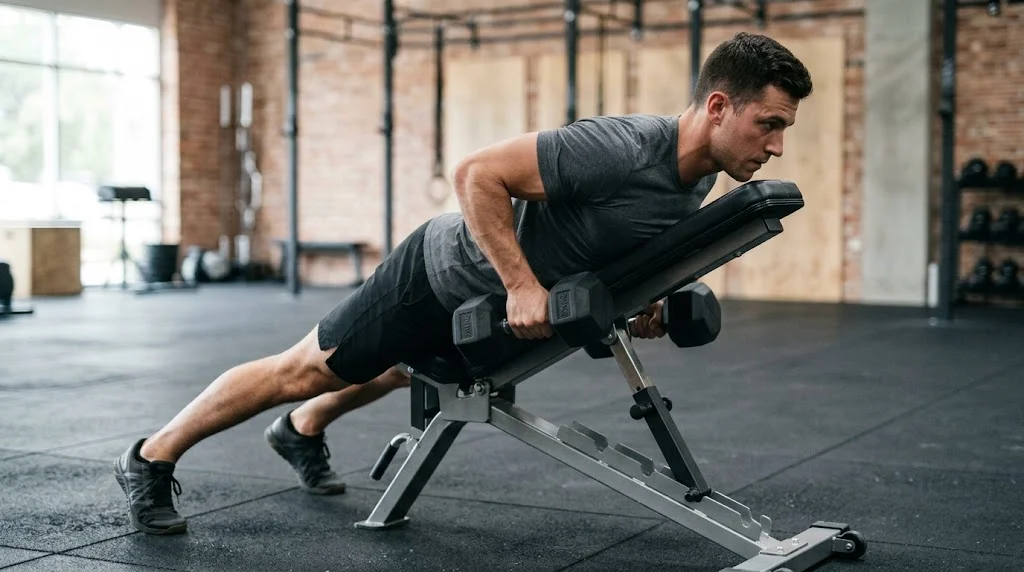
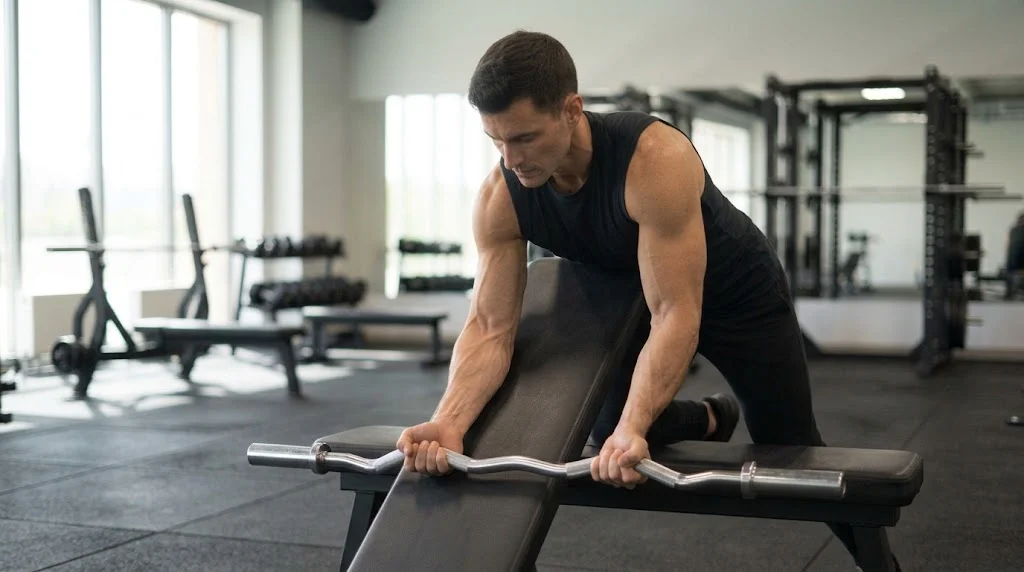
The concentration curl is a single-armdumbbellcurl performed seated, with the working elbow braced against the inside of the thigh. Bracing the arm locks the shoulder and upper arm in place, so the only joint that moves is the elbow. That makes it one of the strictestbicepsexercises available: there is no way to swing the weight or drive it with the hips, and the biceps has to produce every bit of the force. Because the arm sits slightly in front of the torso, the short head of the biceps takes on a bit more of the work, which is why the movement has a reputation for building the visible peak of the arm.
What Muscles Does the Concentration Curl Work?
- Primary: Biceps brachii (short head emphasis)
- Secondary: Brachialis, brachioradialis
- Tertiary: Forearm flexors (grip), anterior deltoid (isometric)
How Do You Set Up for the Concentration Curl?
Sit on the end of a flat bench with your feet flat on the floor and your knees spread wider than hip width. Hold a dumbbell in one hand and lean forward from the hips with a flat back. Brace the back of your working upper arm against the inside of the same-side thigh, just above the knee, and let the arm hang straight down with the palm facing away from your leg. Rest your free hand on the opposite knee for support and keep your shoulders level.
How Do You Perform the Concentration Curl?
- Set your brace with the back of the upper arm pressed firmly into the inner thigh
- Start from a full stretch with the arm hanging straight and the biceps lengthened
- Curl the dumbbell upward by bending only at the elbow, keeping the upper arm pinned against the leg
- Supinate slightly as you curl, turning the pinky up toward your shoulder at the top
- Squeeze at the top for a one second hold where the biceps is fully shortened
- Lower slowly over two to three seconds until the arm is completely straight
- Finish all reps on one arm before switching sides
What Are the Key Form Cues?
- Keep the elbow glued to the thigh: If the upper arm slides forward, the shoulder starts helping
- Reach full extension every rep: The stretched bottom position is where most of the growth stimulus lives
- Turn the pinky up: A slight supination at the top increases the biceps contraction
- Keep the torso still: Rocking the trunk to finish a rep means the weight is too heavy
- Lead with the forearm: Think about bringing the hand to the shoulder rather than lifting the dumbbell
What Are the Most Common Mistakes?
- Using too much weight: Overloading forces the shoulder and torso to assist, which is exactly what this exercise is designed to prevent.
- Cutting the bottom short: Stopping before the arm is straight removes the stretch and shortens the working range.
- Letting the elbow drift: Sliding the arm along the thigh converts the movement into a partial standing curl.
- Rounding the lower back: A collapsed spine under a forward lean puts unnecessary stress on the lumbar area.
- Rushing the lowering phase: Dropping the dumbbell wastes the eccentric portion of every rep.
What Are the Best Concentration Curl Variations?
- Standing concentration curl: Performed bent at the waist with the arm hanging free, no thigh brace
- Cable concentration curl: Low pulley version providing constant tension through the whole range
- Incline concentration curl: Chest supported on an incline bench for a longer stretch
- Preacher curl: Bench-supported alternative locking the upper arm on a pad
- Hammer concentration curl: Neutral grip shifting emphasis toward the brachialis and forearm
How Do You Progress the Concentration Curl?
- Increase weight gradually: Add 2.5 to 5 pounds once you complete all reps with zero body movement
- Increase reps: Build to 12 to 15 strict reps before adding load
- Add a pause: Hold the squeeze for two seconds at the top of each rep
- Slow the eccentric: Take four seconds to lower the dumbbell for more time under tension
How Should You Program the Concentration Curl?
Program concentration curls at the end of an arm or pull session for 3 to 4 sets of 10 to 15 reps per arm. Rest 45 to 60 seconds between arms. This is a finishing movement, not a strength lift, so treat the load as a means to a clean contraction rather than a number to chase. It pairs well after heavier barbell or incline dumbbell curls, when the biceps is already fatigued and a strict, high-rep set does more than more heavy loading would.
Frequently Asked Questions
What is the concentration curl good for?
The concentration curl is one of the strictest biceps isolation exercises, because bracing the elbow against the inner thigh removes all momentum and shoulder assistance. Research on muscle activation has repeatedly ranked it among the highest biceps activators of any curl variation.
Does the concentration curl build the biceps peak?
The concentration curl emphasizes a hard, fully shortened contraction with slight supination, which trains the biceps through the range most associated with the visible peak. The overall shape of your biceps is set by genetics, but this movement develops the muscle that shape depends on.
How much weight should I use for concentration curls?
Use a dumbbell light enough to complete 10 to 15 strict reps with zero body movement, which for most lifters is noticeably lighter than their standing curl weight. If the elbow slides off the thigh or the torso rocks, the weight is too heavy for the exercise to do its job.