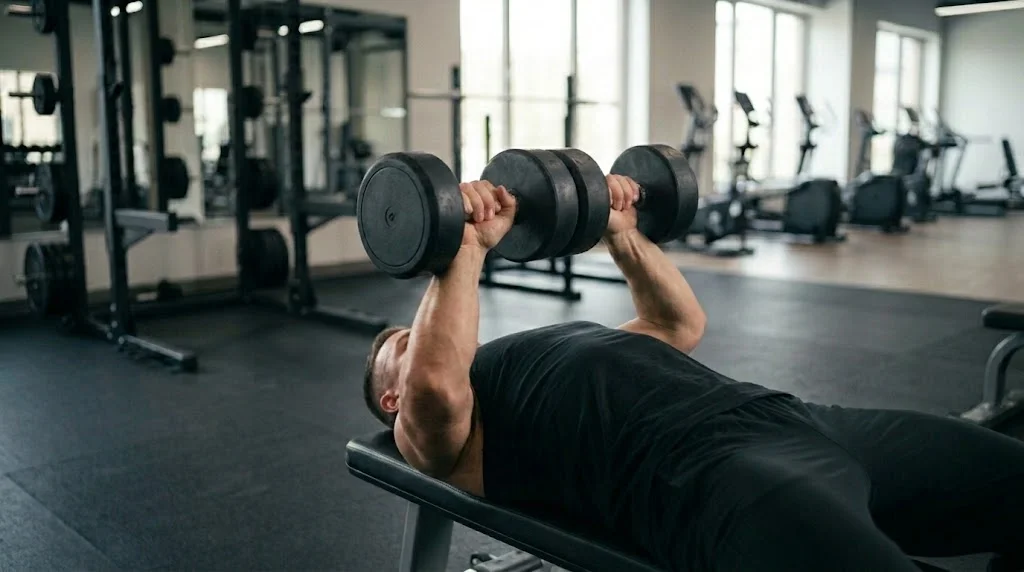
The prone lateral raise is a shoulder isolation exercise performed lying face down on a flat bench, raising light dumbbells out to the sides to train the rear deltoid. Lying prone points the arms straight at the floor, so gravity resists the whole arc and the raise loads the rear delt rather than the side delt, whatever the name suggests. The bench takes the torso out of the equation, which is why it holds less weight than a bent-over row. Lifters program it late in ashoulderor pull session.
What Muscles Does the Prone Lateral Raise Work?
- Primary: Posterior deltoid (rear shoulder)
- Secondary: Middle trapezius, rhomboids, infraspinatus
- Tertiary: Lower trapezius, teres minor, forearm flexors (grip)
How Do You Set Up for the Prone Lateral Raise?
Set a flat bench and lie face down along it with your chest on the pad, forehead just past the end and hips flat. Let your legs hang either side of the pad or brace the toes on the floor. Hold a light dumbbell in each hand with the arms hanging straight down under your shoulders, palms facing back. Pull the shoulder blades down away from your ears until the weights feel connected.
How Do You Perform the Prone Lateral Raise?
- Set the arms hanging straight below the shoulders with a slight elbow bend and the palms facing back.
- Raise both dumbbells out to the sides in a wide arc, leading with the elbows.
- Stop when the arms are level with the bench and the hands sit in line with the shoulders.
- Squeeze the shoulder blades together for one count at the top without shrugging.
- Lower over three counts until the dumbbells hang straight down again.
- Let the weights settle for a moment without touching the floor, then start the next rep.
What Are the Key Form Cues?
- Thumbs turned slightly down: a small inward rotation keeps the rear delt in line with the arc and the upper traps out of it.
- Lead with the elbows: think of pulling the elbows out to the walls rather than lifting the hands, which stops the arms drifting forward.
- Keep the chest pinned to the pad so the torso cannot rock upward.
- Stop the raise where the shoulder blades want to shrug.
- Keep the neck long with the chin off the pad, eyes on the floor.
What Are the Most Common Mistakes?
- Going too heavy: the arms bend, the elbows swing and the traps finish the rep; pick a weight you can raise to shoulder level for 15 slow reps.
- Raising the arms forward instead of out: the path drifts under the chest and the rear delt loses its line of pull; keep the hands wide of the shoulders.
- Lifting the chest off the pad: extending the upper back turns the raise into a row for the mid traps; keep the sternum in contact throughout.
- Shrugging at the top: the upper traps take the last inches; stop at shoulder level with the blades pulled down.
- Dropping the weights on the way back: the eccentric is where the rear delt does most of its work; lower over three counts.
What Are the Best Prone Lateral Raise Variations?
- Bent-over dumbbell lateral raise: standing hinged over, harder on the lower back but no bench needed.
- Incline bench prone lateral raise: chest on a 30 degree incline shortens the range and eases the neck.
- Swiss Ball Dumbbell Rear Delt Raise: the ball supports the chest and exposes any swing.
- Single-arm prone lateral raise: one dumbbell at a time lets you brace with the free hand.
- Cable rear delt raise: a low pulley keeps tension even at the bottom.
How Do You Progress the Prone Lateral Raise?
- Add 5 pounds a hand once every set reaches shoulder level without a shrug.
- Build from 12 reps a set to 20 before changing dumbbells.
- Add a fourth set once three no longer leave the rear delts fatigued.
- Pause two seconds at the top of each rep, or lower over a four count.
How Should You Program the Prone Lateral Raise?
Place the prone lateral raise late in a shoulder or pull session, after presses and rows, two to three times a week. Run 3 to 4 sets of 12 to 20 reps with 30 to 60 seconds of rest, since the load is light and the sticking point is control rather than strength. Pair it with a front raise so the front and rear of the shoulder get matching volume.