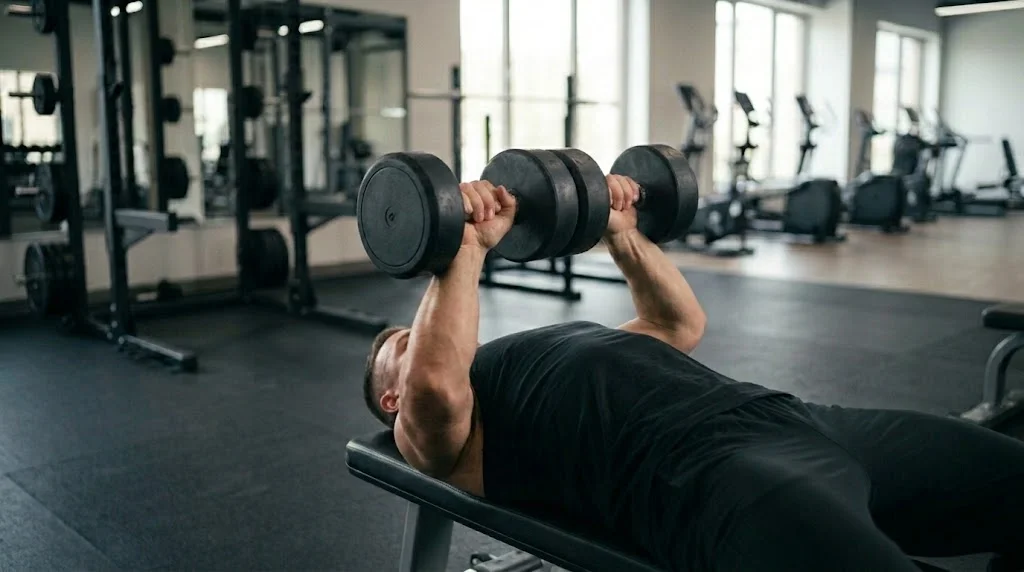
The Swiss-bar incline press is a barbell pressing exercise performed on an incline bench using a Swiss bar (also called a football bar), which has multiple neutral or semi-neutral grip handles running along its length. The fixed neutral grip keeps the palms facing each other throughout the press, reducing rotational stress on the wrists, elbows, and shoulders compared to a straight barbell. It builds the upperchest, front deltoids, andtricepswhile offering a joint-friendly pressing option for lifters managing shoulder discomfort.
What Muscles Does the Swiss-Bar Incline Press Work?
- Primary: Upper pectoralis major, anterior deltoids
- Secondary: Triceps brachii, clavicular chest fibers
- Tertiary: Serratus anterior, core stabilizers
How Do You Set Up for the Swiss-Bar Incline Press?
Set an incline bench to 30-45 degrees and lie back with your feet planted flat on the floor. Grip the Swiss bar at one of its neutral handle positions, hands roughly shoulder-width apart, and unrack it over your upper chest with arms extended. Retract your shoulder blades and keep your chest lifted before lowering the bar for the first rep.
How Do You Perform the Swiss-Bar Incline Press?
- Unrack the bar and position it directly above your upper chest with arms extended
- Lower the bar under control, keeping your elbows at roughly a 45-degree angle from your torso
- Bring the bar down to your upper chest or collarbone, maintaining the neutral grip throughout
- Pause briefly as the bar touches your chest to remove bounce
- Press the bar back up along the same path, driving through your palms
- Extend your arms fully at the top without locking out aggressively
- Repeat for the desired number of reps, keeping shoulder blades pinned to the bench
What Are the Key Form Cues?
- Keep the grip neutral: Let the fixed handles guide your hand position rather than fighting the bar's angle
- Control the elbow angle: Avoid flaring the elbows out to 90 degrees, which stresses the shoulder joint
- Drive through a stable base: Keep your feet flat on the floor and shoulder blades retracted for a solid pressing platform
- Lower with control: Resist the bar on the way down rather than letting it drop to your chest
- Press in a straight line: The bar should travel in a consistent path over your upper chest, not toward your face or stomach
What Are the Most Common Mistakes?
- Setting the incline too steep: Angles above 45 degrees shift emphasis to the shoulders and reduce chest activation. Keep the bench between 30-45 degrees.
- Flaring the elbows: Wide elbow angles increase shoulder strain and reduce pressing efficiency. Keep elbows at roughly 45 degrees from the torso.
- Bouncing the bar off the chest: This reduces muscle tension and increases injury risk. Pause briefly at the bottom instead.
- Partial range of motion: Stopping short at the top or bottom reduces the training stimulus. Lower to the chest and extend arms fully each rep.
- Losing shoulder blade retraction: Letting the shoulders roll forward during the press reduces stability and shifts stress to the front of the shoulder. Keep blades pinned throughout.
What Are the Best Swiss-Bar Incline Press Variations?
- Barbell incline press: Standard straight-bar version with a fixed pronated grip
- Dumbbell incline press: Allows a greater range of motion and independent arm movement
- Swiss-bar flat press: Same neutral grip on a flat bench, shifting emphasis to the mid-chest
- Close-grip Swiss-bar press: Hands positioned on the inner handles increases triceps involvement
- Football bar floor press: Performed lying on the floor for a shorter range of motion and reduced shoulder stress
How Do You Progress the Swiss-Bar Incline Press?
- Increase weight gradually: Add small plates once all reps are completed with full range of motion
- Add pause reps: Hold the bar at the chest for 1-2 seconds to build strength out of the bottom position
- Increase reps before load: Progress to 10-12 reps at a given weight before adding more
- Adjust the incline: Fine-tune the bench angle within the 30-45 degree range to find your strongest, most comfortable pressing groove
How Should You Program the Swiss-Bar Incline Press?
Use the Swiss-bar incline press as a primary or secondary pressing movement in an upper-body or push-focused session, 1-2 times per week. Typical loading is 3-4 sets of 8-12 reps with 90 seconds to 2 minutes of rest between sets. It works well as a shoulder-friendly substitute for the barbell incline press, or paired with flat pressing and triceps isolation work later in the session.