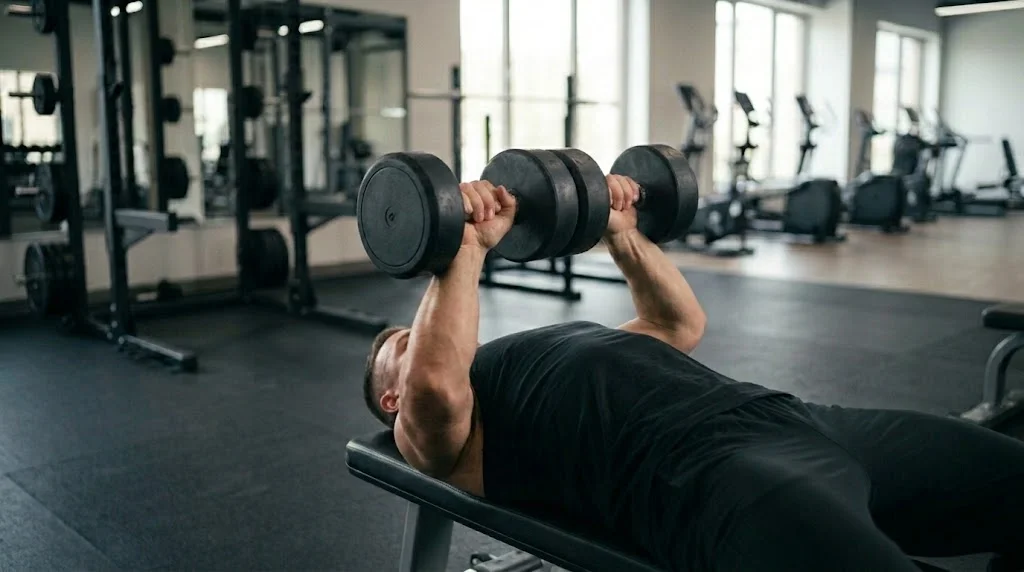
The alternating dumbbell bench press is a flat bench press performed one arm at a time, with the resting dumbbell held at the chest, training the chest and the anti-rotation core. The flat bench keeps the load over the mid chest, and the alternation is what changes: one pec holds an isometric at the bottom while the other presses, and the uneven load tries to roll your torso off the bench, so the obliques and the lat on the loaded side pin you down. Use it as a second chest press.
What Muscles Does the Alternating Dumbbell Bench Press Work?
- Primary: Pectoralis major (mid chest)
- Secondary: Anterior deltoid (front shoulder), triceps brachii
- Tertiary: Obliques, latissimus dorsi, rotator cuff
How Do You Set Up for the Alternating Dumbbell Bench Press?
Sit on the end of a flat bench with a dumbbell resting on each thigh. Lie back and kick both dumbbells to the shoulders as you go down, then press them to arm's length over the mid chest. Plant both feet flat and drive them into the floor, pull the shoulder blades back and down into the bench, and lower both dumbbells to chest height with the palms facing forward.
How Do You Perform the Alternating Dumbbell Bench Press?
- Start with both dumbbells at the chest, elbows tucked to about 45 degrees from the ribs.
- Press the right dumbbell up to a straight arm while the left stays pinned beside the chest.
- Finish over the shoulder joint with the right elbow locked and the dumbbell steady.
- Hold the top for one count, keeping both shoulder blades flat on the bench.
- Lower the right dumbbell under control until it returns beside the chest.
- Press the left dumbbell the same way, then alternate until the reps are done.
What Are the Key Form Cues?
- Bench-side shoulder stays glued: keep the resting arm's shoulder blade pressed into the bench so the torso cannot roll toward the pressing side.
- Squeeze the waiting dumbbell in: hold it tight against the ribs so that pec keeps its stretch instead of resting on the bone.
- Drive both feet into the floor as each arm presses; the leg drive stops the hips shifting.
- Keep the wrist stacked over the elbow so the dumbbell does not tip back over your face.
- Count one rep per arm so both sides finish with the same work.
What Are the Most Common Mistakes?
- Using your normal two-arm dumbbell weight: one side holds an isometric the whole time, so start 5 to 10 pounds a hand lighter.
- Rolling the torso toward the pressing arm: the shoulder blade lifts off the bench and the shoulder loses its stable base, so keep both blades down.
- Parking the resting dumbbell on the chest: that pec unloads and the set becomes two single-arm sets, so hold it just off the ribs.
- See-sawing the arms: starting the second press before the first dumbbell has landed shortens the range at both ends, so finish one rep first.
- Flaring the elbow to 90 degrees from the ribs: the front of the shoulder takes the load at the bottom instead of the chest, so keep the upper arm angled toward the hips.
What Are the Best Alternating Dumbbell Bench Press Variations?
- Dumbbell bench press: both arms press together, allowing more load per side.
- Alternating dumbbell incline press: the same alternation on an incline, shifting the load to the upper chest.
- Dumbbell bench press with neutral grip: palms face each other, tucking the elbows and easing the shoulder.
- Single-arm dumbbell bench press: the free hand holds nothing, so the anti-roll demand is highest.
- Alternating kettlebell floor press: the floor limits the range and the bells hang behind the wrists.
How Do You Progress the Alternating Dumbbell Bench Press?
- Add 5 pounds a hand once you press every set at the top of the rep range with both shoulder blades flat.
- Build from 8 reps per arm to 12 before the next dumbbell jump.
- Add a fourth set when three no longer leave the chest fatigued.
- Hold the waiting dumbbell for two counts beside the chest before each press.
How Should You Program the Alternating Dumbbell Bench Press?
Run this press second on a chest day, after a barbell or two-arm dumbbell bench press, once or twice a week. Work 3 to 4 sets of 8 to 12 reps per arm with 90 to 120 seconds of rest, since each set runs twice as long as a two-arm set. Pair it with achestfly or cable press, which loads the pec without the bracing cost.