Back and Biceps Workout
A pulling session built the way a back actually grows: two directions of pulling, rear delts included, and curls last because they always should be.
The week
Back and biceps
Vertical pull, horizontal pull, rear delts, arms7 moves · 24 setsStraps are allowed on the rows. Your grip failing before your back does is a grip session pretending to be a back session.
| Movement | Sets | Reps | Rest |
|---|---|---|---|
Supinated Bent-Over Barbell RowUnderhand grip, torso around 45 degrees. Pick a weight you can hold that angle with for all four sets. | 4 | 6-8 | 180s |
| 4 | 8-10 | 120s | |
 Chest-Supported Dumbbell Row: Strict Back BuilderThe pad removes every ounce of body English. Expect to drop 20% off what you row standing, and expect your mid-back to notice. Chest-Supported Dumbbell Row: Strict Back BuilderThe pad removes every ounce of body English. Expect to drop 20% off what you row standing, and expect your mid-back to notice. | 3 | 10-12 | 90s |
| 3 | 10-12 | 90s | |
Seated Bent Over Dumbbell Rear Lateral RaiseTiny dumbbells. Rear delts do not respond to ego. | 3 | 15-20 | 60s |
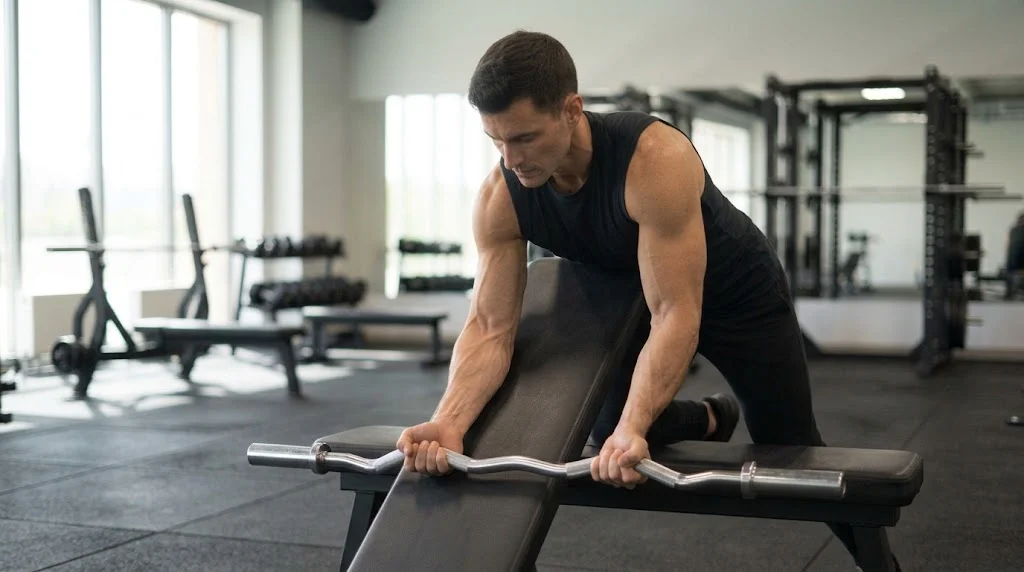 EZ Bar Spider Curl WorkoutChest on an incline bench, arms hanging straight down. There is nowhere to swing from, which is exactly the point. EZ Bar Spider Curl WorkoutChest on an incline bench, arms hanging straight down. There is nowhere to swing from, which is exactly the point. | 4 | 10-12 | 75s |
| 3 | 10-12 each arm | 60s |

Weekly sets per muscle
Counted from the rows above, not typed in by hand. A movement that trains three muscle groups is counted for all three, so these add up to more than the 24 sets in the plan.
Two directions, not one exercise repeated
A back is not one muscle and it doesn't grow from one movement. Pull something down toward you and you load the lats through their long axis. Pull something toward your stomach and you load the mid-back, the rhomboids, the whole middle of your torso.
Skip either and you get a predictable result. All rows, no pulldowns: thick back, no width. All pulldowns, no rows: width with nothing between the shoulder blades. This session runs four sets of each and then adds a third rowing variation, because rowing is where most people are short.
The chest-supported row earns its place
Here's the movement I'd fight to keep if the session had to lose one.
Achest-supported dumbbell rowpins your torso to a pad. No hip drive, no bounce, no leaning back on the last three reps. You will use noticeably less weight than you use on a bent-over row, and every kilogram of it lands where you aimed it.
That's uncomfortable for the ego and excellent for the mid-back. Most people's rowing is 20% back and 80% enthusiasm.
Grip, and why straps aren't cheating
Your forearms will give out before your lats do on the fourth set of a heavy row. When that happens, you've finished a grip workout and abandoned a back workout.
Use straps on the barbell row and the seated cable row. Keep them off the pulldowns and the curls, where grip isn't the limiter anyway. If you want stronger forearms, train them on purpose at the end of a session rather than letting them cap everything else.
Curls at the end, and only at the end
Seven sets of direct arm work sits at the bottom of this page for a structural reason: your biceps assist every single pull above it. Curl first and every row afterwards is compromised.
TheEZ bar spider curlis here because it removes the swing. Chest on an incline bench, arms hanging dead vertical, nothing to generate momentum from. Hammer curls follow to catch the brachialis, which sits under the biceps and pushes it up when it grows.
Is four sets of spider curls plus three of hammers too much after twenty sets of pulling? It would be if you tried to go heavy. Go light and it's the right amount.
Warming up for a pull day
Five minutes of rowing, which warms exactly the muscles you're about to train. Then two ramp-up sets of the barbell row: one light for ten, one at about eighty per cent for five.
Add a set of fifteen band pull-aparts between them if your shoulders feel stiff. That's it. Twenty-four working sets is a long session and the warm-up should not add ten minutes to it.
Where a pull day goes wrong
Row height. Most people row toward their armpit, which turns a mid-back movement into a rear-delt movement with a heavier weight than rear delts should see. Row toward your hip. Your elbow should finish behind your ribs, close to your side.
Momentum. Watch anyone's fourth set of bent-over rows and you'll see the torso angle climb ten degrees a rep until they're doing a standing shrug. The set ended two reps before that. Either stop there or pick a weight where you can hold the angle.
Range on the pulldown. Stopping when the bar touches your collarbone is fine; stopping halfway because the stack is too heavy is not. Your lats do most of their work in the last third of the pull, which is precisely the third that disappears when you overload.
Do you need to arch and lean back on a pulldown? A little, yes. Thirty degrees or so puts the lats in a better line of pull. Sixty degrees is a row.
How heavy is heavy enough?
On the barbell row, a weight you could manage for maybe ten reps with perfect form, used for six to eight. That leaves you a rep or two in reserve on the early sets, which is where you want to be on a movement that loads your lower back.
On everything else, take the last set close to failure. Not to the point where the bar stops moving, but to where you'd need a genuinely good reason to attempt another rep.
If you only have forty minutes
Cut the seated cable row and the hammer curls. That leaves five movements, eighteen sets, and the session still covers both pulling directions plus rear delts.
Don't cut the barbell row and don't cut the rear laterals. One is where the strength comes from and the other is the only thing in the session training a muscle nothing else touches.
Running it as part of a week
Pair this with achest and triceps sessionand a leg day and you've got a three-way split. Drop it into aPPL rotationas your pull day and it fits without edits.
Standalone, once a week, it still does the job. Back responds well to frequency but it also responds to volume, and twenty-four sets in one sitting is real volume.
Frequently Asked Questions
Should I row or pull down first?
Row. A barbell row at six to eight reps is the most systemically demanding thing in the session and it needs your fresh back and fresh lower back. Pulldowns survive fatigue much better. If your lower back is the limiting factor, swap the order and lead with the chest-supported row instead.
Four sets of curls at the end feels like a lot. Is it?
Your biceps have already done twenty sets of assisted work by then, so they are not fresh, and that is fine. Spider curls at the end of a back session are about accumulating work on a pre-fatigued muscle, not about testing strength. Use a weight that makes twelve reps hard and do not add a fifth set.
Why include rear delts in a back workout?
Because nothing else in the session trains them properly. Rows hit the rear delt as a helper, not as the target, and the rear delt is the difference between a back that looks wide and one that looks finished. Three sets of fifteen to twenty with light dumbbells, once or twice a week.
Can I do this twice a week?
Yes, and the back handles it better than almost any other muscle group. Leave three days between runs and drop the barbell row to three sets on the second session. Keep the pulldown volume; that is the part driving width.
1 session a week