Chest and Triceps Workout
One session you can walk in and run today. Heavy pressing first, cable work in the middle, triceps at the end where they belong.
The week
Chest and triceps
Two presses, two flyes, three triceps movements7 moves · 23 setsWarm up with two light sets of the first movement. Those do not count toward the twenty-three.
| Movement | Sets | Reps | Rest |
|---|---|---|---|
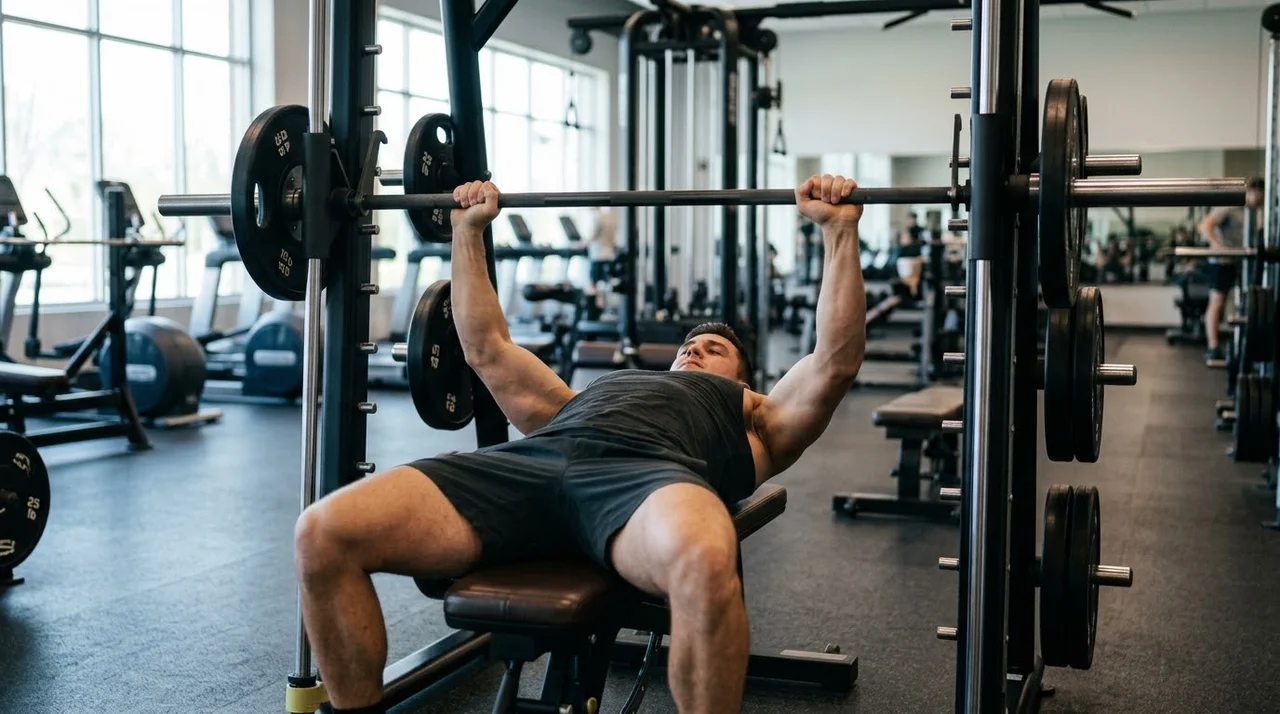 Smith Machine Bench Press: Fixed-Path Chest PressThe heaviest thing you will do today. Pins set at chest height means you can push a set to genuine failure without a spotter. Smith Machine Bench Press: Fixed-Path Chest PressThe heaviest thing you will do today. Pins set at chest height means you can push a set to genuine failure without a spotter. | 4 | 6-8 | 180s |
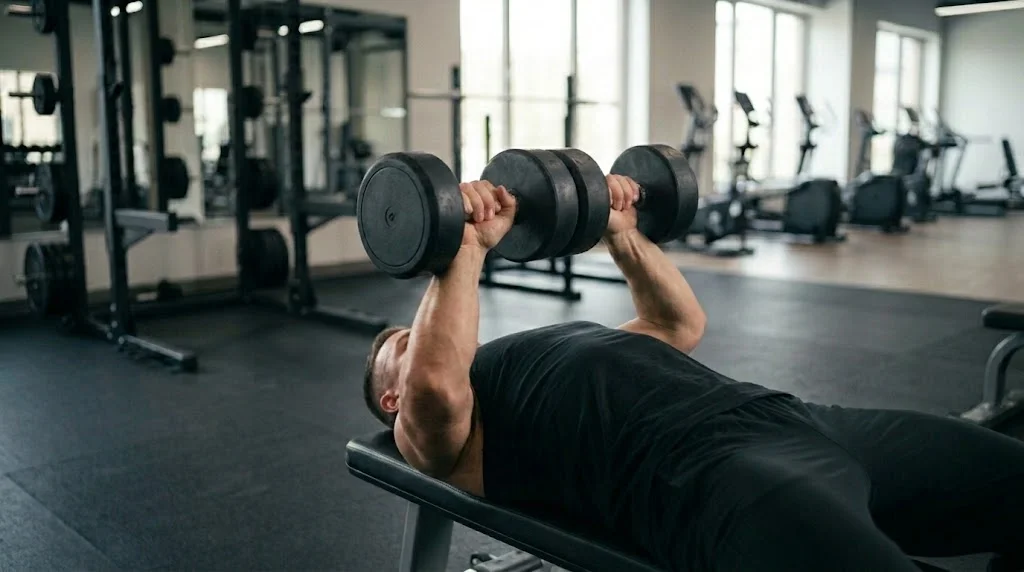 Close Grip Dumbbell Bench Press: Chest & TricepsDumbbells jammed together throughout. This is the movement that bridges the chest work and the triceps work, which is why it sits second rather than last. Close Grip Dumbbell Bench Press: Chest & TricepsDumbbells jammed together throughout. This is the movement that bridges the chest work and the triceps work, which is why it sits second rather than last. | 4 | 8-10 | 120s |
Standing Incline Cable Chest FlyPulleys at the bottom, hands meeting at chin height. Upper chest, in the range where it actually responds. | 3 | 12-15 | 75s |
High Cable Chest FlyNow the pulleys go high and the hands meet at your waist. Same muscle, opposite angle. | 3 | 12-15 | 75s |
| 3 | 8-10 | 120s | |
Triceps Overhead Cable ExtensionOverhead puts the long head on stretch. Skip this and you have trained two thirds of a triceps. | 3 | 10-12 | 75s |
| 3 | 12-15 | 60s |
Weekly sets per muscle
Counted from the rows above, not typed in by hand. A movement that trains three muscle groups is counted for all three, so these add up to more than the 23 sets in the plan.
The order matters more than the exercise list
Seven movements. Twenty-three working sets. Roughly an hour once you honour the rest times, and the rest times are the part people skip.
The shape is deliberate: heavy compound, second compound, isolation, isolation, then triceps. Flip it and do pushdowns first and you'll press less on everything after. That sounds obvious written down, and I've still watched people spend fifteen minutes on cable work before touching a barbell.
Why does theclose grip dumbbell bench presssit second? It's the hinge of the whole session. Dumbbells pressed together loads the inner chest and the triceps at the same time, so it finishes the chest work and starts the arm work in one movement.
The two flyes are doing different jobs
This is the bit I'd defend hardest if someone told me to cut the session down.
A cable fly from low pulleys, hands finishing at chin height, loads the upper chest. A cable fly from high pulleys, hands finishing near your waist, loads the lower chest. The muscle runs at an angle, the fibres pull in different directions, and no single angle covers both.
Three sets of each, twelve to fifteen reps, seventy-five seconds between. Eight minutes total for the pair. That's a cheap way to cover a whole muscle.
Load, and the honest version of it
On the opening press, the target is six to eight reps with the last one genuinely hard. Not "could have done four more" hard. Hard.
On the flyes, you're chasing the stretch at the bottom of the movement. Pick a weight where the stretch is the hardest part, not where the squeeze at the top is the only thing you feel. Most people go about 30% too heavy on cable flyes and turn them into a standing press.
Pushdowns at the end should burn. That's the whole assignment.
Warming up without wasting twenty minutes
Five minutes on a bike or a rower. Then two sets of the opening press: one at about half your working weight for ten, one at eighty per cent for five. Neither counts toward the four.
If your shoulders feel tight at the bottom of a press, add a minute of band pull-aparts between those two sets. That's the entire warm-up and it's enough.
Should you stretch your chest first? No. Static stretching before heavy pressing measurably reduces the force you can produce for the next fifteen minutes or so. Save it for afterwards, when it does no harm and might do some good.
The mistakes I see most on a chest day
Going too heavy on cable flyes. The fly is a stretch movement; if you need to lean into it and turn your elbows into a press, the pin is two plates too low. Most people load a cable fly about a third heavier than they should and then wonder why their front delts are sore and their chest isn't.
Pressing to the same depth every set with no idea where the bar is. On a Smith machine you can and should touch your chest, and the pins are there to make that safe. On dumbbells, go until your upper arms are roughly level with your torso. Half-repping a press because the weight is too heavy is the most common way to do four sets of nothing.
Doing triceps first because the cable station is free. It always is, and it's always a bad trade. Wait two minutes for the bench.
Fitting it into a week
As a standalone session, this slots into any split that separates pushing from pulling. Run it as the chest day in a bro split, as Push A in apush pull legs rotation, or as the one session you do when you've got an hour and no program.
What it isn't is a full week. Train chest and triceps twice on Monday and Thursday with nothing else and you'll develop the posture of a question mark. Pair it with pulling work, and pair it with legs, or accept the consequences.
How heavy, in practice
On the opening press, pick a weight you could grind for about ten reps and stop at six to eight. That leaves a rep or two in the tank on the early sets, which is the right place to be on the one movement carrying your load progression.
On the flyes and the pushdowns, take the final set to the point where the next rep genuinely wouldn't happen. Those movements are cheap to recover from and there's no reason to leave anything behind on them.
The uncomfortable part is that most people have those two backwards: cautious on isolation work, reckless on the press.
If you have forty minutes, not sixty
Cut theclose grip EZ bar pressand one of the two cable flyes. That leaves five movements, seventeen sets, and about forty minutes.
Don't cut the opening press and don't cut the overhead extension. One is where your strength comes from and the other is the only thing here that stretches the long head of the triceps. Everything else is negotiable.
Frequently Asked Questions
How often can I run this session?
Once or twice a week. Twice means leaving at least three days between them, and dropping the second pressing movement to three sets on the second run. The chest recovers faster than most people think; the elbows do not.
My gym has no Smith machine. What do I open with?
Any flat press you can safely take close to failure. A barbell bench press with a spotter, a dumbbell press, or a chest press machine all work. Keep it at six to eight reps and keep it first, because the opening movement is the one carrying the load progression.
Why two cable flyes instead of one?
Because they are not the same exercise. The low-to-high version loads the upper chest fibres and the high-to-low version loads the lower ones, and each takes about four minutes. Doing both costs you eight minutes and covers the whole muscle.
Do I need direct triceps work if I am already pressing?
For the lateral and medial heads, arguably not. For the long head, yes, and that is the one that makes an arm look thick from the side. It crosses the shoulder joint, so it only gets a real stretch when your elbow is overhead, which no press does.
1 session a week