TL;DR: At Target's listed prices on October 23, 2026, two Yes4All 52.5 lb adjustable dumbbell sets, a CAP Strength flat bench and a CAP Barbell doorway bar cost $228.78. Foam tiles take it to $247.77. Buy in that order. The two dumbbells are the gym and everything else is support. Skip multi-station benches, band kits and ladders of fixed dumbbells at this budget.
What Does $300 Have to Cover?
Less than you'd think, and more than most roundups admit. The US government's guidance for adults is muscle-strengthening activity on at least 2 days a week, working all the major muscle groups: legs, hips, back, abdomen, chest, shoulders and arms (CDC adult guidelines). That's a requirement for coverage, not for a particular machine.
So the question isn't "what's the best gear under $300?" It's "which cheap pieces cover the five movements a week of training needs?"
| Movement | What covers it | In the basket |
|---|---|---|
| Squat | Goblet squat, split squat | Dumbbell |
| Hinge | Romanian deadlift | Dumbbells |
| Horizontal push | Floor press, bench press | Dumbbells, then bench |
| Horizontal pull | One-arm row | Dumbbell, then bench |
| Vertical pull | Pull-up, chin-up | Doorway bar |
Four of the five come from dumbbells alone. Only the vertical pull needs a second piece of gear, and that's why a $14.49 bar made the list.
A word on method. I haven't trained on any of this, and I'm not going to pretend I have. I opened the product pages on October 23, 2026, wrote down what they said, and ran the arithmetic in a short script. Where two parts of a page disagreed, I've said so. Prices exclude tax and shipping, and they move.
The Basket, With Prices
| Item | Listing | Price | What the page says |
|---|---|---|---|
| Adjustable dumbbell, 2 sets | Yes4All 52.5 lb, Target | $83.90 each | One 16 x 1 inch handle, eight 5 lb plates, two 2.5 lb, two 1.25 lb, two collars |
| Flat bench | CAP Strength, Target | $46.49 | 600 lb including user, 42.5 x 18 x 19 inches, 18.29 lb |
| Doorway bar | CAP Barbell, Target | $14.49 | 220 lb max, fits 24 to 36 inch doors, screws included and required |
| Floor tiles | Philosophy Gym, Target | $18.99 | 12 tiles, 12 sq ft, 1/2 inch EVA foam, third-party seller |
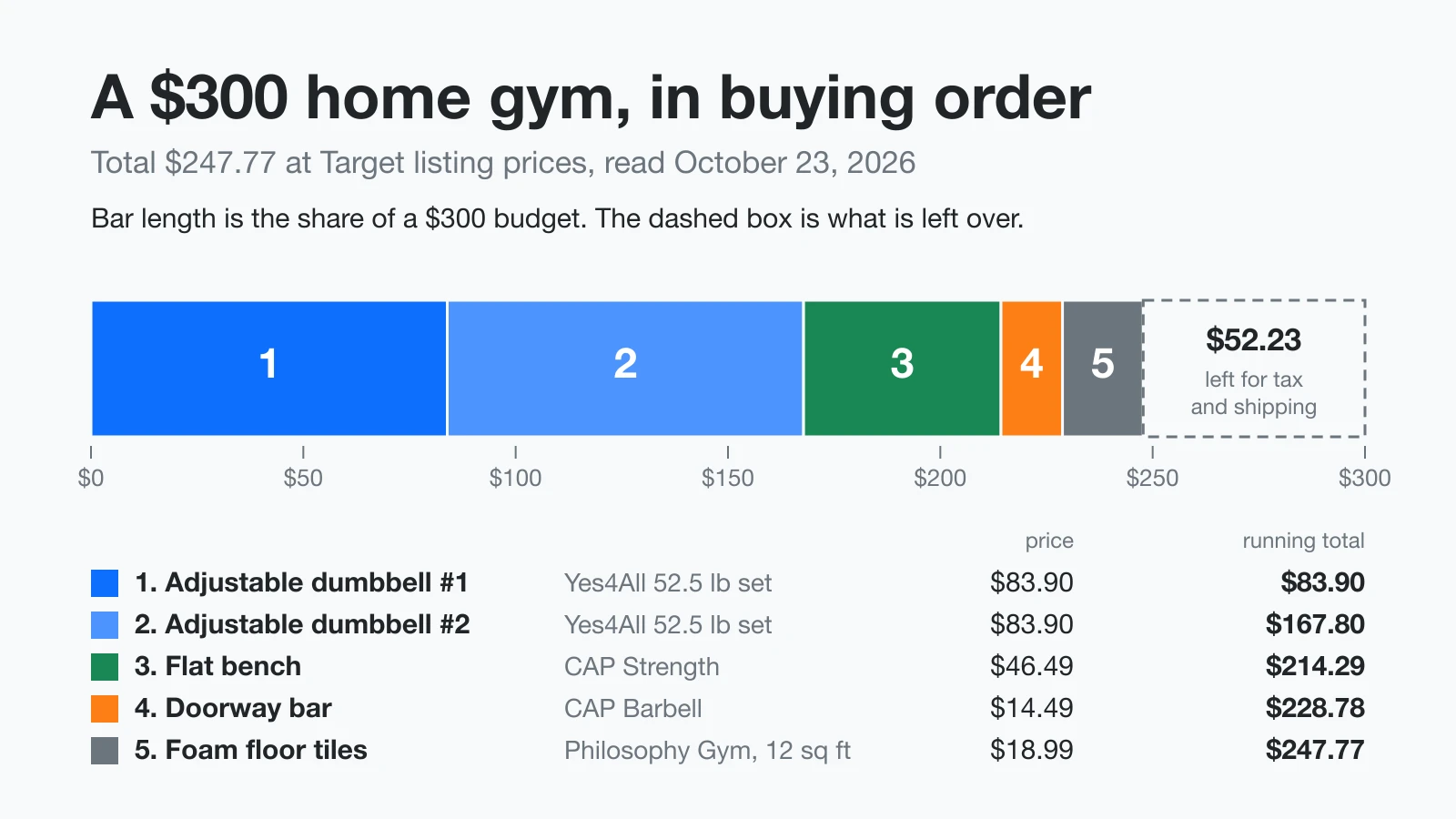 Original chart: the basket in buying order, Target listing prices read October 23, 2026.
Three catches sit behind that table. The Yes4All page showed a quantity of 1 in stock, and it's sold by a third party, Spreetail, whose listing says it only ships with $35 orders. So two sets may mean two separate orders or another retailer. The tile seller is also a third party, with 5 reviews averaging 3.6 stars. And the Yes4All specifications list a weight of 8.6 pounds against the 52.5 in the title, which I can't reconcile.
Why This Order?
Each step has to make the one before it more useful, or it's the wrong step.
1. One dumbbell, $83.90. A single loaded handle does thegoblet squat, the Romanian deadlift and the one-arm row. That's three of the five movements for $83.90.
2. The second dumbbell, $167.80 so far. A pair lets you press with both hands, split squat with load, and carry evenly. It's also the first purchase where the cost changes the training, rather than just adding to it.
3. The bench, $214.29. It adds thedumbbell bench pressand a place to put a rear foot. At 19 inches tall it also works as a step-up platform.
4. The doorway bar, $228.78. It's cheap, which tempts people to buy it first. I'd wait. Someone who can't yet do a pull-up gets little from the bar for weeks, and the dumbbell row covers pulling meanwhile. That's an opinion, and if you can already do five pull-ups, flip steps three and four.
5. The floor, $247.77. Last, and for a reason covered below.
A $300 home gym is a pair of dumbbells with $80 of supporting cast.
The arithmetic holds up: $167.80 for the dumbbells, $79.97 for the bench, bar and tiles together.
Adjustable vs Fixed Dumbbells at This Budget
Does adjustable beat fixed at this budget? I ran two benchmarks to find out. First, price per kilogram of iron.
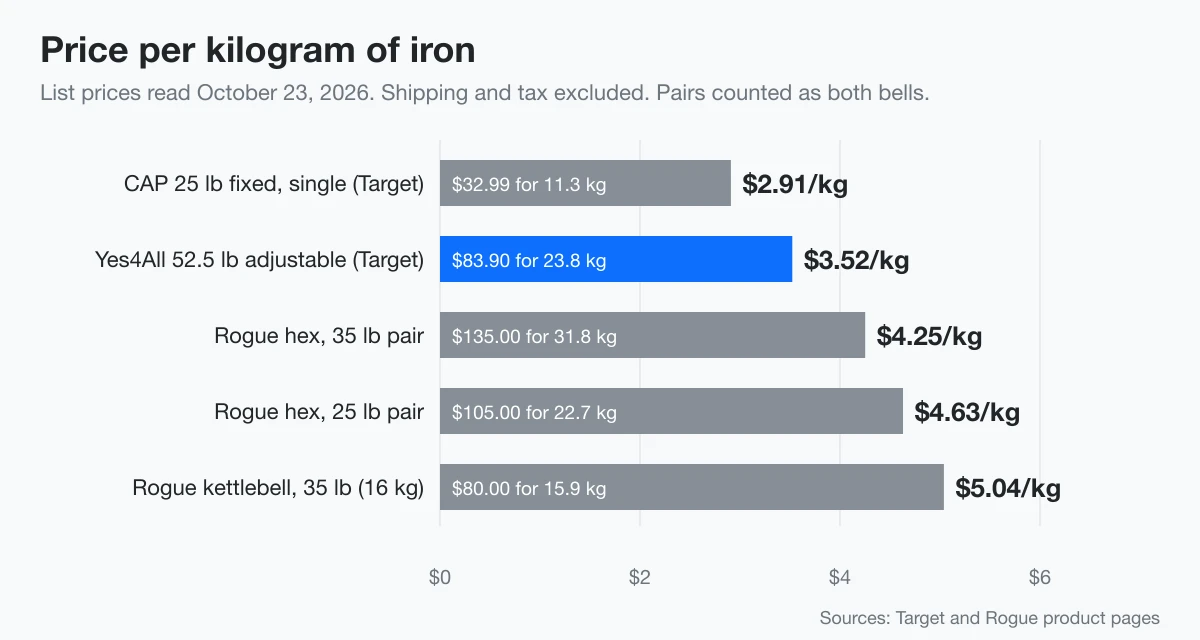 Original chart: price per kg from Target and Rogue pages read October 23, 2026. Pairs counted as both bells.
The cheapest iron per kilogram is a single fixed CAP dumbbell: $32.99 for 25 lb ($28.04 on the clearance price the page showed, which I left out of the chart). The Yes4All set is $3.52 a kilogram, the Rogue rubber hex pairs are $4.25 to $4.63, and Rogue's 35 lb kettlebell is $5.04. Price per kilogram says fixed iron is cheap. It says nothing about how many weights you'll need.
That's the ladder problem. Ourprogressive overload guidecovers ACSM's rule of thumb: raise the load by 2 to 10 percent once you beat your reps twice in a row. The plates in one Yes4All set come in 5, 2.5 and 1.25 lb pieces, so symmetrical loading moves the dumbbell in 2.5 lb steps. The listing doesn't give the handle weight. If the handle and collars make up the 5 lb left over after 47.5 lb of plates, a dumbbell goes from 5 to 52.5 lb in 20 settings, and every step from 25 lb up is 10 percent or less. Between 10 and 25 lb the steps are 11 to 25 percent. Treat that 5 lb as my inference, not a spec.
Rogue's hex ladder between 10 and 50 lb has 12 steps, and 2 of them are 10 percent or less. What does the full ladder cost?
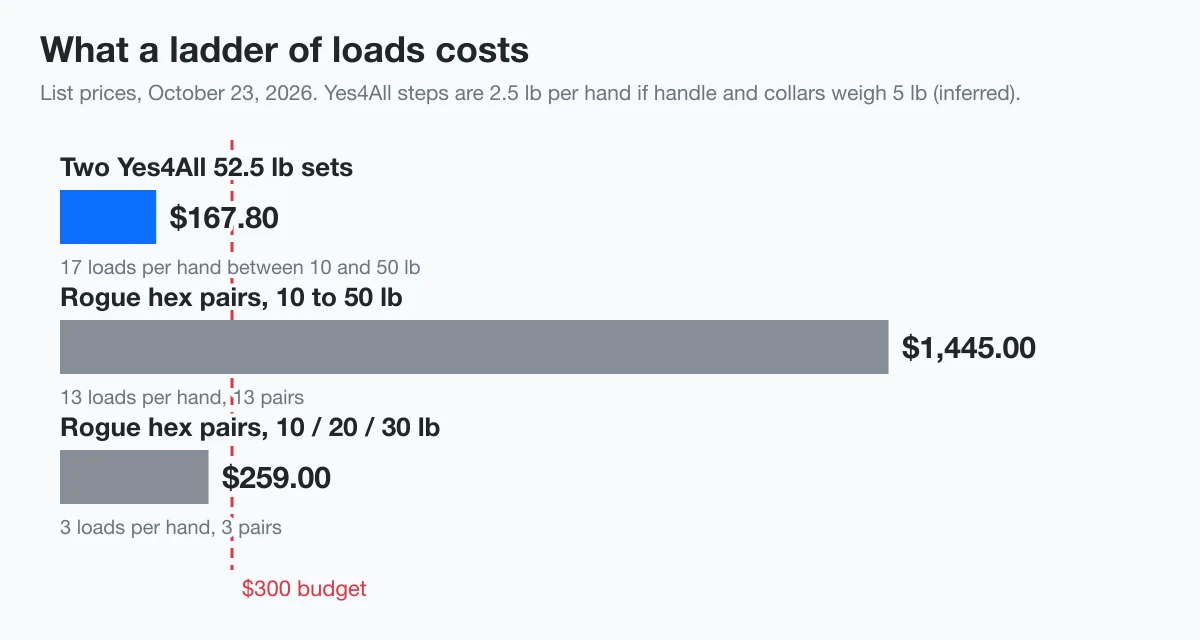 Original chart: cost of covering 10 to 50 lb per hand, list prices read October 23, 2026. The Yes4All step size is inferred from the plate list.
It isn't a fair fight on quality. Rogue's dumbbells are rubber-coated, and they need no collars and no plate swapping. But it's a fair fight on this budget. Three Rogue pairs, 10, 20 and 30 lb, cost $259.00 and leave $41 for a bench that costs $46.49. The ladder you need is the one you can afford.
Ouradjustable dumbbell comparisoncovers the trade you accept with spinlock dumbbells: slower changes in exchange for more weight per dollar. A kettlebell is a different question, and thedumbbell vs kettlebell guideshows why it comes second.
Where the Listings Disagree With Themselves
I read these pages closely because a spec sheet is a claim, not a measurement. Several of them contradicted themselves, and that's worth knowing before you trust a number.
- CAP Strength flat, incline and decline bench ($69.99): the specifications say it holds up to 300 pounds. The highlights say a recommended maximum of 500 lb and a test to 1,000 lb under an ASTM standard. It had 0 reviews.
- ProsourceFit Multi-Grip Lite doorway bar ($28.99): the highlights give a 24 to 32 inch door, a Q&A answer says 24 to 36, and the page mentions a J bracket and mounting hardware while its specifications say no assembly is required and a Q&A answer says it needs screws. It does have 76 ratings averaging 4.43.
- Marcy multi-station bench ($219.99):"reg $569.99, $350 off" on the page, a 600 lb capacity in the highlights and 300 lb in the specifications, and a title that says foldable while a Q&A answer says it isn't.
- Yes4All set: the specifications list 8.6 pounds, as mentioned above.
When a listing contradicts itself on capacity, I'd treat the lower number as the real one. That's a rule of thumb, not a safety rating.
What Not to Buy Under $300
Multi-station benches. The Marcy bench with a leg developer is $219.99, which is 73 percent of the budget, and its own page can't agree on what it holds. A bench with attachments is a bench plus parts you'll rarely use. Ourhome gym equipment guidemakes the same argument about all-in-one machines at higher budgets.
A ladder of fixed dumbbells. Covered above. At Rogue's prices the budget buys three pairs and no bench.
Band kits as the main tool. The ProsourceFit set of five tube bands with handles was $32.99 and out of stock, and the page gave two different resistance ranges for the yellow and green bands. Bands are fine for rehab and travel, and the same home gym guide says to skip them as the primary load.
A kettlebell first. Rogue's 35 lb (16 kg) bell is $80 in powder coat and $85 in E-coat, about the price of one adjustable dumbbell, and the dumbbell changes weight when you do.
A no-screw doorway bar. I looked for one, since many people rent. The one Target listing I opened was $69.00, sold by a third party named Ukoke, with 0 reviews. That one purchase would eat nearly a quarter of the budget.
The Floor Problem
Ourflooring guidegives a thickness ladder: 3/8 inch for bodyweight work, 1/2 inch for dumbbell training with incidental drops, 3/4 inch for barbell work. The tiles in this basket are 1/2 inch EVA foam. They'll cushion your knees and stop bench feet from marking a floor. They aren't rubber, and I wouldn't trust them to absorb a 50 lb dumbbell dropped from shoulder height.
The proper fix is a 4 by 6 foot, 3/4 inch rubber stall mat, and this is where the budget gets messy. Big D's page listed one at $62.95, 155 lb, shipped by freight with a minimum $225 delivery charge. A Valley Wide Cooperative page listed a 4 by 6 barn mat at $84.99, with 44 in stock at one Idaho store and shipping marked available. Tractor Supply sells one too, but its page returned an access error to me, so I have no verified price for it. A stall mat is a pickup purchase. Check what's near you before counting it in the $300.
That's why the foam tiles come fifth, not first. If you're lifting on carpet or a basement slab, drop the tiles and put the money toward a mat.
What $300 Won't Do
Be honest about the ceiling. Fifty-two and a half pounds per hand is a real limit for a goblet squat or a split squat, and a beginner will pass it on those lifts before passing it on a lateral raise.
Does that make it a bad buy? A 2018 opinion paper in Frontiers in Physiology, citing an earlier meta-analysis, notes that light-load training taken to failure produced whole-muscle growth similar to heavy-load training (Grgic and Schoenfeld). The authors also say many low-load groups in the underlying studies didn't train to failure, and most participants were untrained. I couldn't open the meta-analysis itself, so I'm relying on that summary. It covers muscle size and says little about strength, so I wouldn't assume light loads match heavy ones there. For a first year of training, I'd worry about the missing second dumbbell before the ceiling.
What it can't do is barbell work. When you want that, theRogue adjustable bench breakdownand our10 by 10 foot layout guideare the next stops, and thehome gym vs gym membership mathputs a $300 start against a monthly fee. Ourbeginner full-body programruns on dumbbells and a bench, with the substitutions already written.
One more opinion you can argue with: spend the first $168 and stop for a month. If you're still training in four weeks, the bench, the bar and the floor are easy to justify. If you aren't, you've spent a lot less than a membership contract.