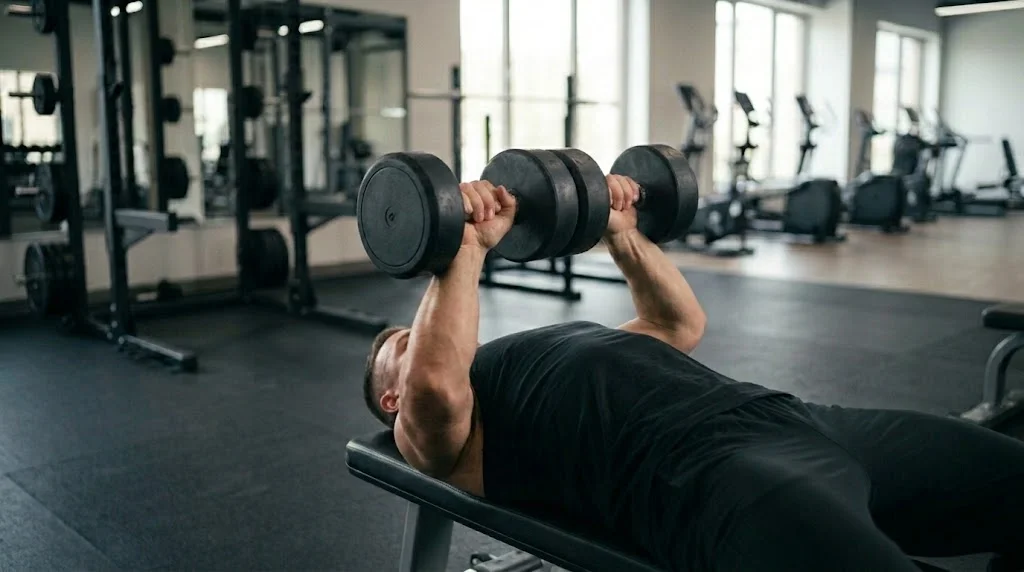
The incline dumbbell fly with twist is a chest isolation exercise performed on an incline bench, combining the standard arcing fly motion with a wrist rotation (supination) as the dumbbells come together at the top. The added twist increases peak contraction in the upper chest and improves the mind-muscle connection compared to a standard fly. It primarily targets the clavicular (upper) head of the pectoralis major, with secondary involvement from thefront deltoids.
What Muscles Does the Incline Dumbbell Fly With Twist Work?
- Primary: Pectoralis major (upper/clavicular head)
- Secondary: Anterior deltoids
- Tertiary: Biceps brachii (during the wrist rotation), core stabilizers
How Do You Set Up for the Incline Dumbbell Fly With Twist?
Set an incline bench to a 30-45 degree angle. Lie back with adumbbellin each hand, feet flat on the floor. Press the dumbbells up above your chest with palms facing each other and a slight, fixed bend in your elbows, positioning the weights directly over your shoulders.
How Do You Perform the Incline Dumbbell Fly With Twist?
- Brace your core and set a slight, fixed bend in your elbows
- Lower the dumbbells out to the sides in a wide arc, keeping the elbow bend constant, until you feel a stretch across your chest
- Stop when your upper arms are roughly parallel to the floor to protect the shoulder joint
- Reverse the arc, bringing the dumbbells back up and together over your chest
- Rotate your wrists inward as the dumbbells meet at the top, so your palms briefly face away from each other
- Squeeze your chest at the top before untwisting and lowering for the next rep
- Repeat for the desired number of reps, keeping the movement smooth and controlled throughout
What Are the Key Form Cues?
- Keep a fixed, slight elbow bend throughout: don't let the movement turn into a press by extending the elbows
- Lead the twist with your forearms and wrists, not your whole arm
- Control the descent: the bottom stretch position carries the highest shoulder strain, lower slowly
- Squeeze and hold the twisted position briefly at the top for maximum contraction
- Keep your shoulder blades pulled back and down against the bench throughout the set
What Are the Most Common Mistakes?
- Bending and straightening the elbows during the movement: this turns the fly into a press and shifts stress onto the triceps, keep elbow angle fixed
- Lowering the dumbbells too far: overstretching the shoulder joint at the bottom increases strain risk, stop when upper arms are roughly parallel to the floor
- Using momentum to swing the weights up: this reduces chest tension and increases injury risk, slow the tempo in both directions
- Twisting too early or too late in the range: timing the rotation away from the top reduces the peak-contraction benefit, twist only as the dumbbells meet
- Using too much weight: heavy dumbbells force elbow bending and shorten the range of motion, choose a weight that allows a full, controlled arc
What Are the Best Incline Dumbbell Fly With Twist Variations?
- Standard incline dumbbell fly: same movement without the wrist twist, useful for lifters new to the exercise
- Flat dumbbell fly with twist: shifts emphasis to the mid-chest rather than the upper chest
- Low-to-high cable fly: constant cable tension replaces gravity-based resistance, useful for isolating the upper chest
- Single-arm incline fly with twist: unilateral version that increases stability demand and addresses imbalances
- Incline dumbbell press: a compound alternative that allows heavier loading of the same upper-chest region
How Do You Progress the Incline Dumbbell Fly With Twist?
- Increase weight in small increments (2.5-5 pounds per dumbbell) only once the twist and full range of motion are consistent
- Slow the eccentric phase to increase time under tension before adding load
- Add a one- to two-second squeeze at the top of the twist to intensify the peak contraction
- Progress the bench angle gradually, starting closer to 30 degrees and moving toward 45 as upper-chest strength improves
How Should You Program the Incline Dumbbell Fly With Twist?
Use the incline dumbbell fly with twist as an isolation or finishing movement in a chest session, after heavier compound pressing work such as bench or incline presses. Perform three sets of 10-15 reps with light-to-moderate weight, resting 45-60 seconds between sets. Its isolation focus and added contraction cue make it well suited to higher-rep, higher-volume chest-focused training days.