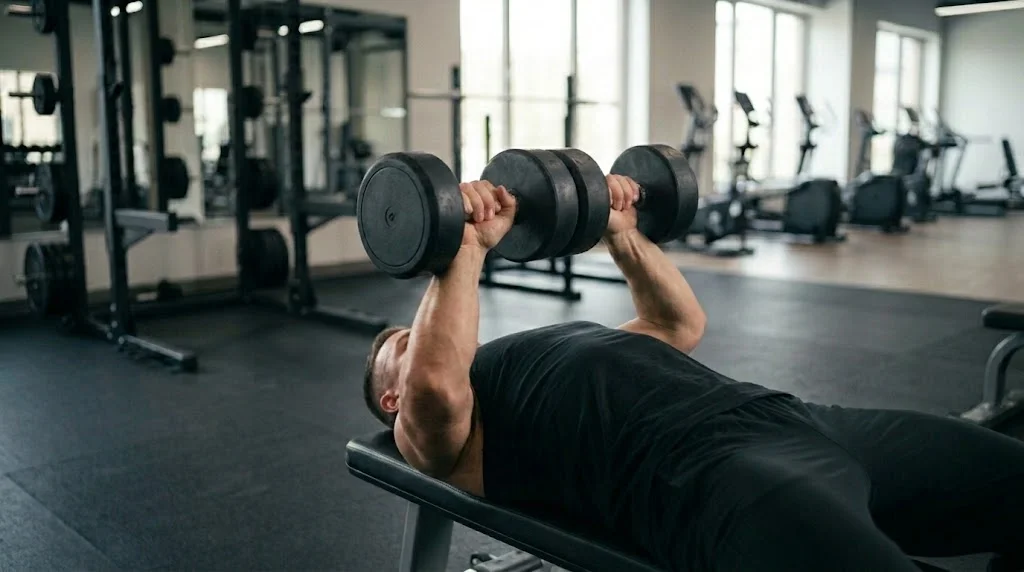
The decline hex press is a dumbbell chest press performed on a decline bench with two dumbbells squeezed together throughout, aiming the press line over the lower chest. The decline is the only thing separating it from the flathex press: with your head below your hips the arms press down the body line, so the sternal fibres of the pec finish the rep and the front delt has less to do. The inward squeeze still never lets up. Lifters run it as a second chest movement after a heavy press.
What Muscles Does the Decline Hex Press Work?
- Primary: Pectoralis major, sternal head (lower and inner chest)
- Secondary: Triceps brachii, anterior deltoid
- Tertiary: Serratus anterior, biceps brachii, rectus abdominis
How Do You Set Up for the Decline Hex Press?
Set the bench to a 15 to 30 degree decline and hook your feet under the leg pads. Sit up with a hex dumbbell on each thigh, then lie back with your shoulder blades pinned into the pad. Turn your palms to face each other and press the flat sides of the dumbbells together over your lower chest. Tuck the elbows beside your ribs, keep the wrists straight, and squeeze the dumbbells inward.
How Do You Perform the Decline Hex Press?
- Crush the dumbbells together over your lower chest with the elbows tucked and the handles parallel.
- Press away from your chest along the line of your torso, pushing the dumbbells into each other the whole way.
- Lock out over the lower chest with the arms straight and no gap showing between the flat sides.
- Hold the top for one count, squeezing inward hard without letting the shoulders roll forward.
- Lower over two counts until the dumbbells touch your chest, still pressed together.
- Pause on the chest, reset the inward squeeze, and press the next rep.
What Are the Key Form Cues?
- Push the dumbbells into each other: hold that inward pressure from the chest to lockout, as if making one dumbbell.
- Press down your body line: on a decline the bar path runs toward your feet, not toward your face.
- Keep your shoulder blades driven into the pad so the shoulders do not roll up at lockout.
- Hook the feet and keep the hips down so you are not sliding toward the low end.
- Feel the lower chest tighten at the top rather than the triceps finishing the rep.
What Are the Most Common Mistakes?
- Going heavy: the dumbbells separate at the top and the lift becomes a narrow decline press, so use a pair you can crush together on every rep.
- Letting a gap open at lockout: the pecs unload where the squeeze should peak, so stop an inch short if you cannot hold contact.
- Turning the palms forward: a pronated grip cannot hold the flat sides together and the movement is just a decline press, so keep the grip neutral.
- Flaring the elbows on the descent: the dumbbells slide off each other and the front of the shoulder takes the load, so keep the arms beside the ribs.
- Sitting up to hand the dumbbells off: getting up under load on a decline strains the low back, so have a partner take them or lower them to your thighs first.
What Are the Best Decline Hex Press Variations?
- Dumbbell Floor Hex Press: the floor stops the elbows early, the easiest entry to the squeeze.
- Flat hex press: a level bench gives a longer bottom range and less lower chest bias.
- Incline hex press: a 30 degree incline moves the squeeze to the upper chest.
- Single-arm decline hex press: one dumbbell held between both palms while the trunk resists the twist.
- Decline close grip dumbbell press: the same narrow path with the dumbbells held apart, so heavier loads work.
How Do You Progress the Decline Hex Press?
- Add 5 pounds a hand once every set hits the top of the rep range with no gap at lockout.
- Work from 10 reps up to 15 with the same pair before moving up.
- Add a fourth set once three no longer leave the chest fatigued.
- Hold the lockout squeeze for three counts, or lower for a four-count, when the next pair is too heavy.
How Should You Program the Decline Hex Press?
Place the decline hex press second or third on a chest or push day, after your barbell or dumbbell bench press. Train it one to two times a week for 3 to 4 sets of 10 to 15 reps with 60 to 90 seconds of rest. Pair it with a dip or a cable fly so the lower chest also works through the long range the squeeze cuts short.