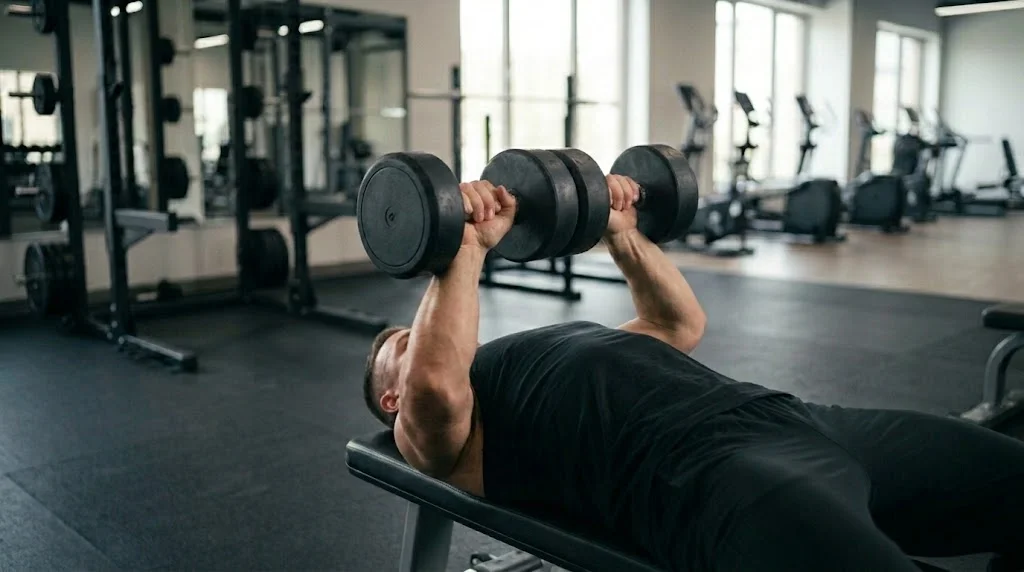
The stability ball dumbbell chest press is a horizontal pressing movement performed lying on a stability ball that trains thechestwhile the glutes and trunk hold the body level. Compared with the bench version, the ball supports only your upper back, so your hips become a bridge you have to hold, and the soft surface punishes any difference in speed between the two dumbbells. It caps the load you can use, which is the point: you learn to press with two arms that move together. Program it as a second chest movement after a barbell or machine press.
What Muscles Does the Stability Ball Dumbbell Chest Press Work?
- Primary: Pectoralis major (sternal and clavicular heads)
- Secondary: Anterior deltoid (front shoulder), triceps brachii
- Tertiary: Gluteus maximus, hamstrings, rectus abdominis, serratus anterior
How Do You Set Up for the Stability Ball Dumbbell Chest Press?
Choose a ball that puts your knees at ninety degrees when you sit on it. Sit with a dumbbell resting on each thigh, then walk your feet forward until the ball sits under your upper back and shoulder blades, head supported. Plant your feet flat and hip-width apart, drive your hips up until your torso is level, and kick the dumbbells to your chest with your palms facing forward and forearms vertical.
How Do You Perform the Stability Ball Dumbbell Chest Press?
- Set your shoulder blades back and down into the ball and squeeze your glutes so your hips stay level with your shoulders.
- Press both dumbbells up together until your arms are straight over your mid-chest, moving them slightly toward each other.
- Stop just short of touching at the top, elbows extended but not locked, dumbbells above your shoulders.
- Hold for a one-count with the plates almost touching while your hips stay up and the ball stays still.
- Lower under control over two to three seconds until the dumbbells sit level with the top of the ball.
- Pause at the bottom, re-squeeze your glutes and press again; after the last rep bring the dumbbells to your thighs and sit up.
What Are the Key Form Cues?
- Keep your hips as high as your shoulders: think of your body as a tabletop from knees to head for the whole set, not just at the top.
- Press both hands to the same ceiling tile: the ball rocks the instant one dumbbell leads, so watch the plates travel together.
- Drive your feet into the floor on the way up to keep the ball from rolling backward.
- Pull your elbows slightly under the dumbbells at the bottom so the press starts from your chest, not your shoulders.
- Breathe out through the press and inhale at the top.
What Are the Most Common Mistakes?
- Loading the dumbbells you use on a bench: the ball cannot hold that weight steady and the reps turn short and jerky; start with about two-thirds of your bench-press dumbbells.
- Dropping the hips: sagging into a decline turns the exercise into a lower-chest press and unloads the glutes, so re-squeeze between reps.
- Letting the ball roll toward your head: it lands under your neck instead of your shoulder blades, so walk your feet back in and reset.
- Flaring the elbows to ninety degrees at the bottom: on an unstable surface this loads the front of the shoulder capsule under a shifting weight, so keep the elbows at roughly forty-five degrees from your torso.
- Dumping the dumbbells to the floor at the end: the sudden unloading rolls the ball out from under you; bring them to your thighs first.
What Are the Best Stability Ball Dumbbell Chest Press Variations?
- Dumbbell bench press: the same pattern on a fixed bench, for lifters who cannot yet hold a bridge.
- Single-arm stability ball dumbbell chest press: one dumbbell at a time forces the obliques to stop the ball rotating, a big step up.
- Stability ball dumbbell incline press: hips dropped below the shoulders to shift work to the upper chest.
- Alternating stability ball dumbbell press: one arm presses while the other stays locked out, for shoulder stability.
- Stability ball dumbbell fly: arms wide with soft elbows, more chest stretch at lower loads.
How Do You Progress the Stability Ball Dumbbell Chest Press?
- Add 5 pounds per hand once every set reaches the top of your rep range without the ball moving.
- Work from 8 up to 15 reps per set before increasing the weight, since stability, not strength, is the limiter.
- Add a fourth set before adding load once the bridge holds for all three.
- Lengthen the pause at the bottom to two seconds, or slow the descent to a four-count, once the load stops going up.
How Should You Program the Stability Ball Dumbbell Chest Press?
Place the stability ball dumbbell chest press second or third in a chest session, after a barbell or machine press. Train it once or twice per week for 3 to 4 sets of 8 to 15 reps with 60 to 90 seconds of rest. It pairs well with a row or a face pull in the same block, since both keep the shoulder blades working while the glutes recover for the next set.