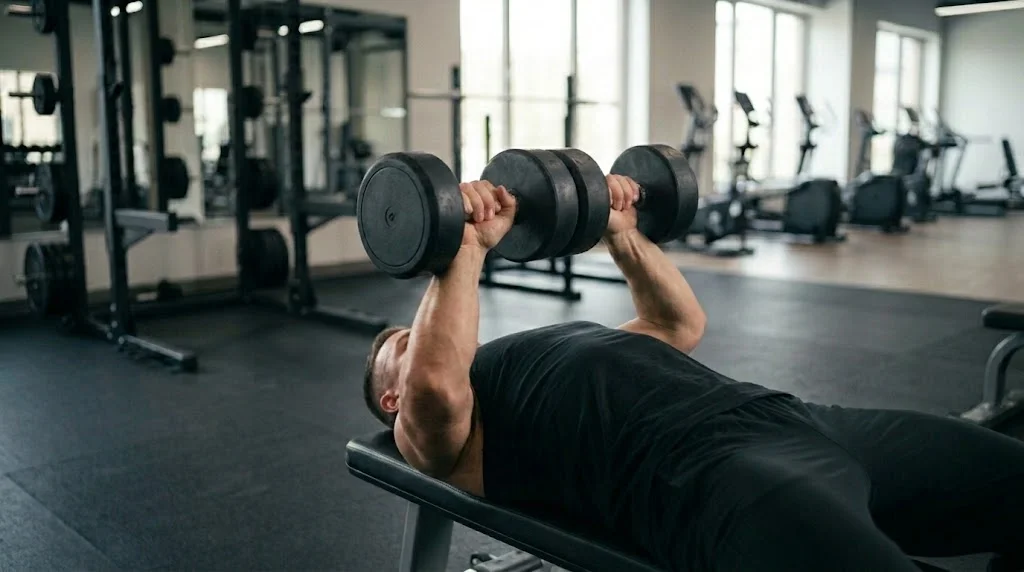
The Swiss ball dumbbell chest press is a horizontal pressing exercise performed lying on a stability ball with a dumbbell in each hand, training the pectorals while the hips and trunk hold a bridge. Because the ball supports only your upper back, your glutes and hamstrings hold the hips level where a bench would, and every uneven press tries to roll the ball sideways, so both arms must move in time. The trade is lighter loads than a bench press for more shoulder and trunk stability. Lifters use it as a secondchestmovement or when no bench is free.
What Muscles Does the Swiss Ball Dumbbell Chest Press Work?
- Primary: Pectoralis major (mid chest)
- Secondary: Anterior deltoid, triceps brachii
- Tertiary: Gluteus maximus, hamstrings, rectus abdominis, serratus anterior
How Do You Set Up for the Swiss Ball Dumbbell Chest Press?
Choose a ball that puts your knees at 90 degrees when you sit on it, and dumbbells lighter than your bench pair. Sit on the ball with the dumbbells on your thighs, then walk your feet forward until the ball rests under your upper back and head. Set the feet flat, shoulder width apart, and drive the hips up until your torso is flat. Kick the dumbbells to your chest, palms forward.
How Do You Perform the Swiss Ball Dumbbell Chest Press?
- Lock the bridge by squeezing the glutes and bracing the abs, then press both dumbbells to arm's length over the chest.
- Lower the dumbbells together, elbows about 45 degrees from the torso, until the upper arms drop just below the ball line.
- Stop when you feel the chest stretch and the dumbbells sit level with each other at the outer edge of the chest.
- Pause for a beat at the bottom without letting the hips sag or the ball shift.
- Press both dumbbells up and slightly in, finishing with the weights above the shoulders and the arms straight but not locked hard.
- Squeeze the chest for one second at the top, check the hips are still level, and begin the next rep.
What Are the Key Form Cues?
- Hips high, ribs down: hold the bridge like a plank turned over; if the hips drop the ball takes the load and the chest loses its base.
- Press through the palms evenly: any lag in one arm shows up as the ball rolling toward that side.
- Keep the feet heavy on the floor; they are half your base.
- Keep the shoulder blades pulled back and down against the ball throughout the rep rather than reaching forward at the top.
- Breathe in on the way down and out through the press so the trunk stays braced.
What Are the Most Common Mistakes?
- Loading the same dumbbells as your bench press: the bridge cannot hold them and the reps turn into a shaky half press; start well lighter.
- Letting the hips sag toward the floor: the torso slopes down, the press becomes a decline, and the lower back takes the strain; drive the glutes up before every rep.
- Pressing one arm ahead of the other: the ball rolls and the trunk twists; press both hands to the top together.
- Flaring the elbows straight out at the bottom: the shoulder joint sits at its most exposed position under load; keep the elbows around 45 degrees from the body.
- Walking the ball too far up the back: it ends under the neck and the head hangs off the edge; stop when the upper back and head are both supported.
What Are the Best Swiss Ball Dumbbell Chest Press Variations?
- Dumbbell bench press: the same press on a fixed bench, the regression for building load.
- Single-arm Swiss ball chest press: one dumbbell at a time, a heavy anti-rotation demand.
- Swiss ball incline press: hips sit lower for an angle that shifts the work to the upper chest.
- Alternating Swiss ball chest press: one arm presses while the other holds the top, less total load.
- Bosu ball dumbbell chest press: the dome gives a wider, lower base for lifters not yet steady on the ball.
How Do You Progress the Swiss Ball Dumbbell Chest Press?
- Add 5 pounds per hand once you complete all sets at the top of the rep range with the hips level.
- Work from 8 reps up to 12 per set before moving up in weight.
- Add a set per week, from 3 up to 4.
- Slow the lowering phase to three seconds, or pause two seconds at the bottom without letting the ball move.
How Should You Program the Swiss Ball Dumbbell Chest Press?
Place the Swiss ball dumbbell chest press second in a chest or push session, after a barbell or dumbbell bench press, or first when no bench is free. Train it once or twice per week for 3 to 4 sets of 8 to 12 reps with 60 to 90 seconds of rest. Pair it with a rowing movement so the shoulders get balanced pulling work after the pressing.