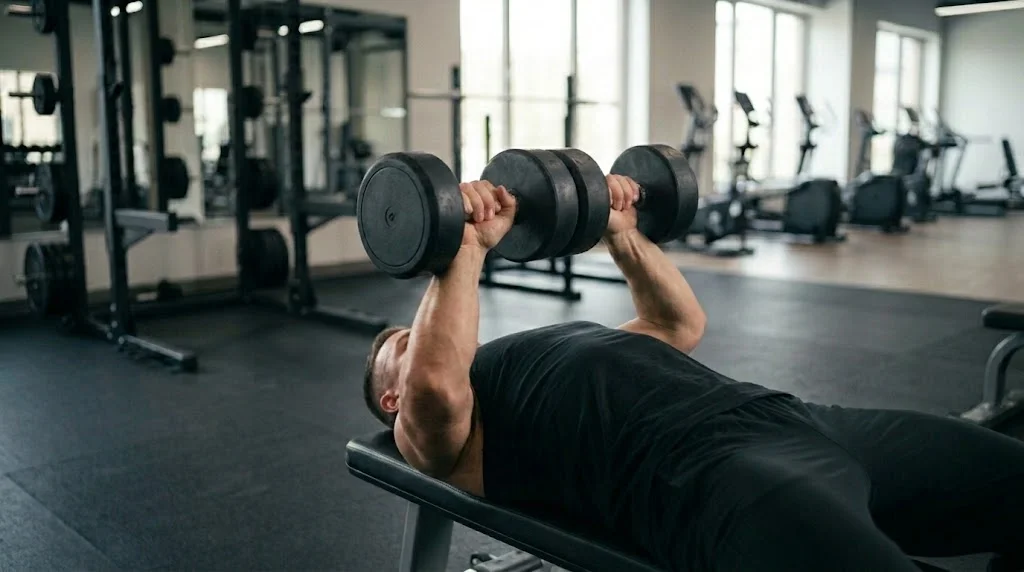
The seated dumbbell chest press is a compound pressing exercise performed upright on a back-supported bench, pressing two dumbbells forward from the chest to train the pectorals. Because the torso is vertical and the press travels horizontally, the pad takes the weight the way a machine chest press does while the dumbbells still move on a free path, so each arm has to stabilise its own load. The range at the front is shorter than adumbbell bench pressand the shoulders stay in a lower-stress position. Lifters use it as a second chest movement after a flat press.
What Muscles Does the Seated Dumbbell Chest Press Work?
- Primary: Pectoralis major (sternal and clavicular heads)
- Secondary: Anterior deltoid (front shoulder), triceps brachii
- Tertiary: Serratus anterior, rotator cuff, rectus abdominis
How Do You Set Up for the Seated Dumbbell Chest Press?
Set an adjustable bench upright, between 80 and 90 degrees, with a dumbbell on each side. Sit with your feet flat and wider than hip width, hips pushed back into the seat and upper back flat against the pad. Lift the dumbbells to the sides of your chest, palms forward, elbows bent to about ninety degrees and just below shoulder height. Draw your shoulder blades back and down into the pad.
How Do You Perform the Seated Dumbbell Chest Press?
- Pin your shoulder blades to the pad and set the dumbbells level with the lower chest, forearms vertical.
- Press both dumbbells straight forward away from the chest, letting them drift slightly inward as the arms extend.
- Stop just short of lockout when the dumbbells nearly touch in front of your sternum and the elbows are almost straight.
- Squeeze the pecs for one count with the shoulder blades still pinned to the pad.
- Lower the dumbbells back under control along the same path until the elbows pass behind the line of the torso.
- Reset the dumbbells beside the chest with the forearms vertical and repeat without letting the shoulders roll forward.
What Are the Key Form Cues?
- Push the pad with your upper back: Drive your shoulder blades into the bench as you press so the chest, not the shoulder, leads the dumbbells forward.
- Press on a shallow arc: Let the dumbbells converge toward the midline at the finish, which is where the pec fibres shorten most.
- Keep the wrists stacked over the elbows at the bottom of every rep.
- Feel the stretch across the chest before you start each press.
- Keep your feet heavy on the floor so the seat, not your torso, absorbs the load.
What Are the Most Common Mistakes?
- Choosing dumbbells you cannot control at the bottom: heavy weights drop into the stretched shoulder, so pick a load you can lower for a full three count.
- Letting the shoulders roll off the pad at the finish: reaching forward with the shoulder unloads the pec and pushes the humeral head forward, so end the press with the blades still on the bench.
- Flaring the elbows straight out to the sides: a ninety-degree elbow angle at the bottom drives the shoulder toward impingement, so tuck the elbows below shoulder height.
- Pressing upward instead of forward: the dumbbells turn the move into a half shoulder press, so keep the path level with the chest.
- Arching off the pad to finish reps: the low back leaves the seat and the press turns into a partial decline press, so keep the hips back.
What Are the Best Seated Dumbbell Chest Press Variations?
- Machine chest press: fixed path and a handle instead of two free weights, for learning the press before stabilising dumbbells.
- Incline dumbbell chest press: the bench set to 30 to 45 degrees shifts work to the upper chest.
- Neutral-grip seated dumbbell press: palms facing each other keep the elbows tucked, easier on the shoulders.
- Single-arm seated dumbbell chest press: one dumbbell at a time adds an anti-rotation demand for the trunk.
- Dumbbell chest press on stability ball: swaps the pad for a ball and adds a balance demand.
How Do You Progress the Seated Dumbbell Chest Press?
- Add five pounds per hand once you press every rep of every set with the shoulder blades on the pad.
- Work from 8 up to 12 reps before increasing the dumbbells.
- Add a fourth set, or a second chest session in the week, before adding both load and reps together.
- Slow the lowering phase to three seconds and pause one count at the chest.
How Should You Program the Seated Dumbbell Chest Press?
Program the seated dumbbell chest press as the second pressing movement on a chest or upper-body day, after a barbell or dumbbell bench press. Train it one to two times per week for 3 to 4 sets of 8 to 12 reps, resting 60 to 90 seconds between sets. It pairs well with a cable fly or a row to balance the pressing volume with pulling work.