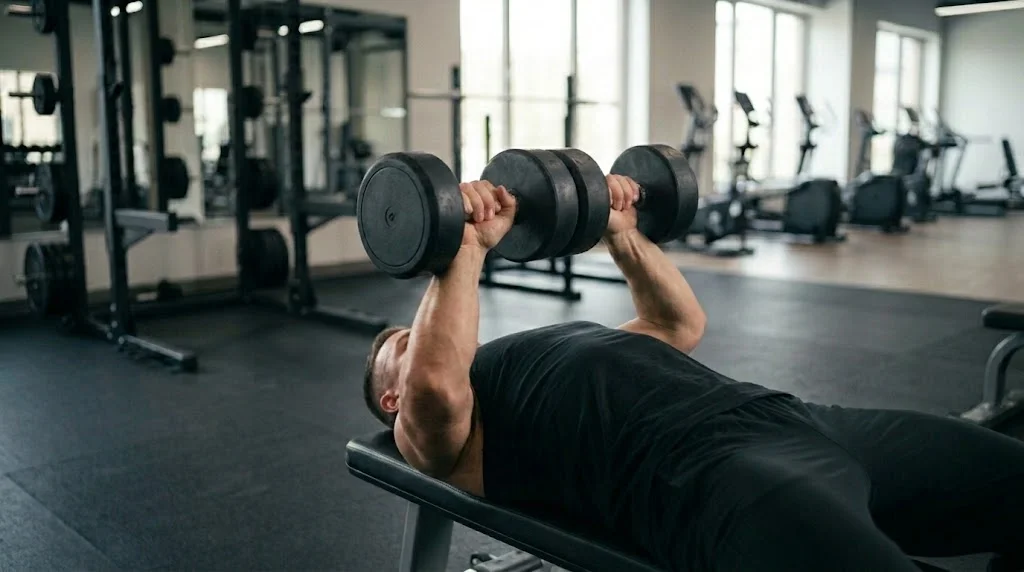
The decline dumbbell pullover is a single-dumbbell isolation exercise performed lying head-down on a decline bench, lowering the weight behind the head to stretch and train the chest and lats. The decline angle drops the head below the hips, so the dumbbell travels further before gravity stops pulling on it and the stretch at the bottom runs deeper than on a flat bench. The leg pads also pin the hips, which stops the rib flare and lower-back arch that a flat pullover invites. Coaches program it as a late chest or back accessory after the pressing and rowing work.
What Muscles Does the Decline Dumbbell Pullover Work?
- Primary: Pectoralis major (sternal chest), latissimus dorsi (lats)
- Secondary: Triceps brachii long head, teres major, serratus anterior
- Tertiary: Rectus abdominis (abs), posterior deltoid, forearm flexors
How Do You Set Up for the Decline Dumbbell Pullover?
Set a decline bench to 15 to 30 degrees and hook your legs under the pads with your head at the low end. Lie back with your shoulders and head on the bench. Hold one dumbbell with both hands, palms flat against the underside of the top plate. Press it over your chest with a slight elbow bend, pull your shoulder blades down, and brace your abs so the ribs stay down.
How Do You Perform the Decline Dumbbell Pullover?
- Lock the elbow bend at a slight angle and keep it fixed; the shoulder is the only joint that moves.
- Lower the dumbbell in an arc over your face and behind your head, letting the upper arms travel back beside your ears.
- Stop at the stretch point, where the dumbbell is level with or slightly below the head and the ribs are still down.
- Hold the stretch for a count, feeling the chest and lats lengthen without the lower back leaving the bench.
- Pull the dumbbell back over along the same arc, driving the upper arms toward the ceiling through the chest and lats.
- Finish over the chest, not over the hips, with the arms vertical, and pause before the next rep.
What Are the Key Form Cues?
- Pull with the upper arms, not the hands: Imagine your elbows dragging the dumbbell over so the lats and chest start the lift.
- Keep the ribs glued to the bench: Exhale into the stretch so the lower ribs stay down instead of flaring to reach.
- Feel the stretch across the chest and under the armpits at the bottom, not in the shoulder joint.
- Stop the return at vertical; passing over the hips drops the tension to nothing.
- Squeeze the dumbbell plates together to keep the shoulders packed through the arc.
What Are the Most Common Mistakes?
- Picking a dumbbell too heavy to control behind the head: the elbows bend and the lift becomes a triceps extension, so choose a load you can lower slowly with fixed elbows.
- Arching the lower back to chase depth: extending the lumbar spine under a dumbbell behind the head loads the low back at end range, so stop the arc when the ribs start to lift.
- Bending and straightening the elbows during the rep: a changing elbow angle turns the pullover into a skull crusher, so lock the bend before the first rep.
- Bringing the dumbbell down to the hips: pulling past vertical unloads the chest and lats, so finish the rep over the face.
- Letting the head lift off the bench: craning to watch the dumbbell strains the neck, so keep the head down and eyes on the ceiling.
What Are the Best Decline Dumbbell Pullover Variations?
- Dumbbell pullover on flat bench: the flat version with a shorter arc and less stretch, easier to learn.
- Stiff-arm dumbbell pullover: locked elbows lengthen the lever for a harder version at the same weight.
- Cross-bench dumbbell pullover: lying across the bench lets the hips drop for a deeper chest stretch.
- Single-arm decline dumbbell pullover: one dumbbell at a time adds anti-rotation work through the trunk.
- Lying cable pullover: a low pulley behind the bench keeps tension constant instead of fading at the top.
How Do You Progress the Decline Dumbbell Pullover?
- Add 5 pounds to the dumbbell once you complete all sets at 15 reps with the ribs down and the elbows fixed.
- Build from 10 up to 15 reps per set before the next load jump.
- Add a set at a time up to 4 sets, or a second session per week.
- Add a two-count pause at the stretch and a three-count return rather than adding load when the shoulders feel it.
How Should You Program the Decline Dumbbell Pullover?
Place the decline dumbbell pullover late in a chest or back session, after presses and rows. Train it 1 to 2 times per week for 3 to 4 sets of 10 to 15 reps, resting 45 to 75 seconds between sets. Pair it with a decline press or a dumbbell fly in a chest session, or with a lat pulldown in a back session, so the stretched position gets loaded once per week each way.