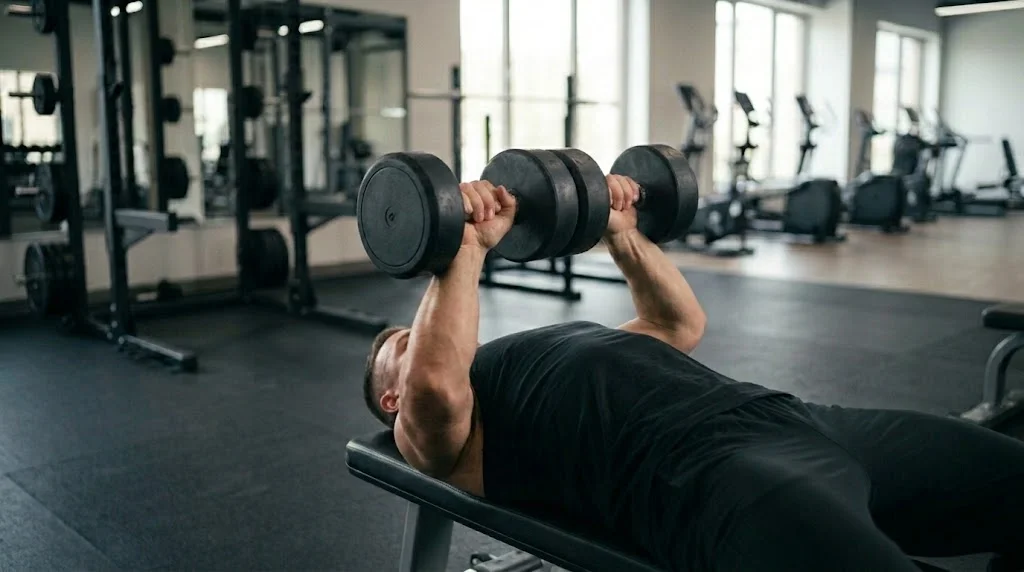
The dumbbell pullover on flat bench is a single-dumbbell isolation exercise performed lying on a flat bench, lowering the weight behind the head to stretch and train the chest and lats. Lying along the bench, the upper arms can drop below the torso line at the bottom and the shoulder reaches full overhead extension with nothing to stop the arc. That free range is the point of the flat version and its demand: the hips are unpinned, so the ribs and lower back must hold still. Coaches program it as a late chest or back accessory.
What Muscles Does the Dumbbell Pullover on Flat Bench Work?
- Primary: Pectoralis major (sternal chest), latissimus dorsi (lats)
- Secondary: Triceps brachii long head, teres major, serratus anterior
- Tertiary: Rectus abdominis (abs), rhomboids, forearm flexors (grip)
How Do You Set Up for the Dumbbell Pullover on Flat Bench?
Stand a dumbbell on end at the head of a flat bench. Lie along the bench with your head near the end and the feet flat on the floor. Reach back and take the dumbbell with both hands, palms flat against the underside of the top plate, and press it over your chest with a slight elbow bend. Pull the shoulder blades down and press the lower back into the bench.
How Do You Perform the Dumbbell Pullover on Flat Bench?
- Fix a slight elbow bend and keep it for the whole rep; only the shoulders move.
- Lower the dumbbell in an arc over the face and past the end of the bench, the upper arms travelling beside the ears.
- Stop when the upper arms drop below the bench line and the dumbbell hangs behind the head with the ribs still down.
- Pause at the stretch for a count, feeling the chest and lats lengthen while the lower back stays on the pad.
- Pull the dumbbell back over along the same arc, the upper arms leading toward the ceiling.
- Finish with the arms vertical over the chest, reset the shoulder blades down, and begin the next rep.
What Are the Key Form Cues?
- Elbows lead the arc: drag the dumbbell over with the upper arms so the chest and lats start the lift, not the hands.
- Ribs down through the bottom: exhale as the weight passes behind the head so the lower ribs do not flare to chase depth.
- Feel the stretch under the armpits and across the chest, never in the front of the shoulder joint.
- Keep the head resting on the bench with the eyes on the ceiling.
- Stop the return at vertical; the tension drops to nothing once the dumbbell passes over the hips.
What Are the Most Common Mistakes?
- Choosing a dumbbell too heavy to hold behind the head: the elbows bend to cope and the movement becomes a triceps extension, so pick a weight you can lower slowly with a fixed elbow.
- Arching the lower back off the bench at the bottom: with the hips unpinned, the lumbar spine extends under load at end range, so stop the arc when the lower back starts to lift.
- Dropping the dumbbell into the stretch: the shoulder takes the load at its longest position with no control, so lower over a two-count.
- Pulling the dumbbell down to the hips: the arc past vertical unloads the chest and lats, so finish over the face.
- Sliding the head off the end of the bench: the neck hangs unsupported and cranes with each rep, so keep the head on the pad.
What Are the Best Dumbbell Pullover on Flat Bench Variations?
- Dumbbell pullover on floor: the floor stops the arms at head level, a shorter regression that spares the shoulder.
- Decline dumbbell pullover: the head-down angle lengthens the arc and pins the hips, the harder progression.
- Cross-bench dumbbell pullover: lying across the bench with the hips dropped adds depth and rib expansion.
- Single-arm dumbbell pullover on flat bench: one lighter dumbbell per side, the trunk resisting rotation.
- Lying cable pullover: a low pulley behind the bench holds tension at the top where the dumbbell goes light.
How Do You Progress the Dumbbell Pullover on Flat Bench?
- Add 5 pounds to the dumbbell once you complete all sets at 15 reps with the lower back on the bench throughout.
- Build from 10 reps per set up to 15 before the next load jump.
- Add a set at a time up to 4, or a second session per week.
- Add a two-count pause at the stretch and a three-count return when the next dumbbell is too big a jump.
How Should You Program the Dumbbell Pullover on Flat Bench?
Place the dumbbell pullover on flat bench late in a chest or back session, after the presses or rows. Train it 1 to 2 times per week for 3 to 4 sets of 10 to 15 reps, resting 45 to 75 seconds between sets. Pair it with a flat dumbbell fly in a chest session or a straight-arm pulldown in a back session so the lengthened position is loaded twice.