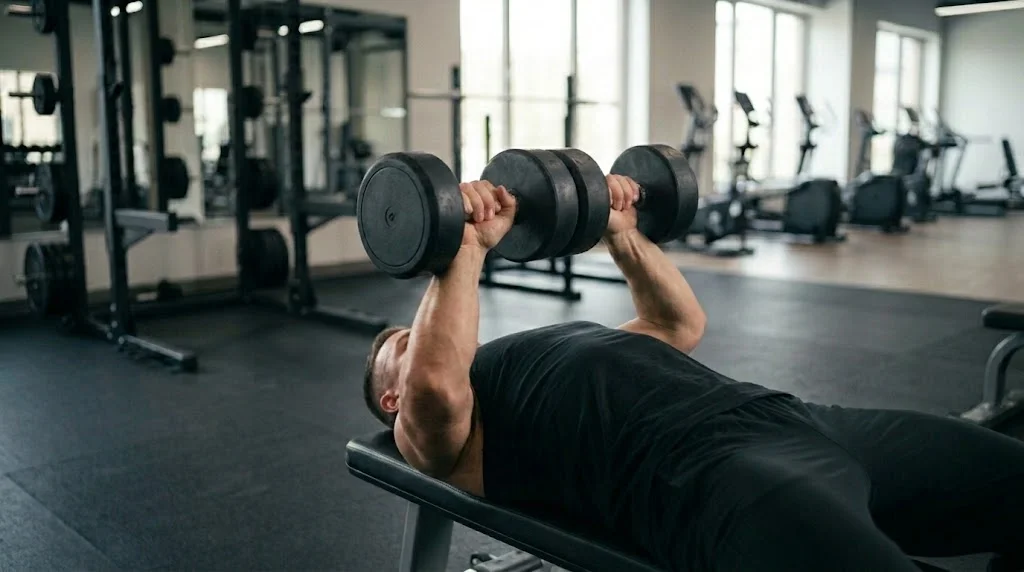
The rolling barbell chest fly is a lying isolation exercise that recreates the wide arcing path of a dumbbell fly using a single barbell instead of two dumbbells. Lying on a flatbench, you lower the bar out to the sides in a rolling arc, rotating your wrists as your arms open, then reverse the arc back to lockout above the chest. It targets the pectoralis major through a long stretch-to-contraction range and is best suited to lifters who already have solidshoulder mobilityand bar control, since the fixed bar removes the independent arm path a dumbbell fly allows.
What Muscles Does the Rolling Barbell Chest Fly Work?
- Primary: Pectoralis major
- Secondary: Anterior deltoids, pectoralis minor
- Tertiary: Triceps (stabilizing), serratus anterior
How Do You Set Up for the Rolling Barbell Chest Fly?
Lie flat on a bench with your feet planted on the floor and your lower back in light contact with the pad. Take a narrow overhand grip on the bar, hands roughly 6-10 inches apart, and press it to arm's length directly above your chest with a slight bend in your elbows. This narrow grip is what allows the wide arcing "fly" path rather than a standard pressing path.
How Do You Perform the Rolling Barbell Chest Fly?
- Begin the descent by opening your arms out to the sides in a wide arc rather than bending your elbows down toward your chest
- Rotate your wrists slightly as the bar travels down and out, rolling the bar to keep it aligned with your changing arm angle
- Lower until you feel a deep stretch across your chest, keeping the slight elbow bend fixed throughout the descent
- Reverse the arc by squeezing your chest to pull the bar back up and inward along the same wide path
- Roll your wrists back as the bar approaches the top, returning to the narrow overhead lockout position
- Pause briefly at the top with the chest fully contracted before starting the next repetition
- Keep the movement slow and controlled throughout, since the fixed bar makes the bottom position less stable than a dumbbell fly
What Are the Key Form Cues?
- Keep the elbow bend constant: A fixed slight bend throughout protects the elbows and keeps tension on the chest rather than the triceps
- Lead with the stretch, not the weight: Lower only as far as your shoulders comfortably allow before opening further
- Roll the wrists deliberately: The rotation is what keeps the bar path natural through the wide arc - do not force it
- Keep your feet planted and back stable: A stable base prevents the bar from wandering off its arc
- Use a lighter load than you would for a barbell press: This is a stretch-focused isolation movement, not a pressing strength exercise
What Are the Most Common Mistakes?
- Turning it into a close-grip bench press: Bending the elbows and driving the bar straight up trains the triceps instead of the chest. Keep the arc wide and the elbows only slightly bent.
- Using too much weight: Excess load makes the wide bottom position unstable and increases shoulder strain. Choose a weight that lets you control the full arc.
- Lowering too far: Dropping below a comfortable stretch range stresses the shoulder joint. Stop the descent once you feel a full chest stretch.
- Rushing the wrist roll: Failing to rotate the wrists with the bar path creates an awkward, unstable bottom position. Coordinate the roll with the arc smoothly.
- Skipping a spotter or safety awareness: Because the bottom position is inherently less stable than a dumbbell fly, use lighter loads or a spotter until you are confident in the pattern.
What Are the Best Rolling Barbell Chest Fly Variations?
- Dumbbell fly: Standard variation with independent arm paths and a more stable bottom position
- Cable fly: Provides constant tension throughout the range instead of peak tension at the bottom
- Pec deck machine fly: Guided, more beginner-friendly way to train the same stretch-contraction pattern
- Incline barbell rolling fly: Bench set to a slight incline shifts emphasis toward the upper chest
- Single-arm dumbbell fly: Unilateral variation that removes the bar-control challenge entirely
How Do You Progress the Rolling Barbell Chest Fly?
- Increase weight gradually: Add small plates (2.5-5 lbs per side) once you can complete all sets with full control and no bar wobble
- Increase reps: Build up to the top of your rep range (around 12) before adding load
- Slow the eccentric: Take 3-4 seconds to lower the bar through the arc to increase time under tension
- Add a pause at the stretch: Hold briefly at the bottom of the arc to increase the stretch-mediated stimulus before progressing load
- Master the pattern unloaded first: New lifters should groove the wrist-roll and arc with an empty bar before adding plates
How Should You Program the Rolling Barbell Chest Fly?
Use the rolling barbell chest fly as a chest isolation or finishing movement 1-2 times per week after heavier pressing work, since the unstable bottom position calls for the pecs to already be warmed up. Typical loading is 10-12 reps per set for 2-3 sets with a light to moderate bar weight, resting 60-90 seconds between sets. Because it demands more coordination than a standard dumbbell fly, master the pattern with an empty bar or very light weight before progressing.