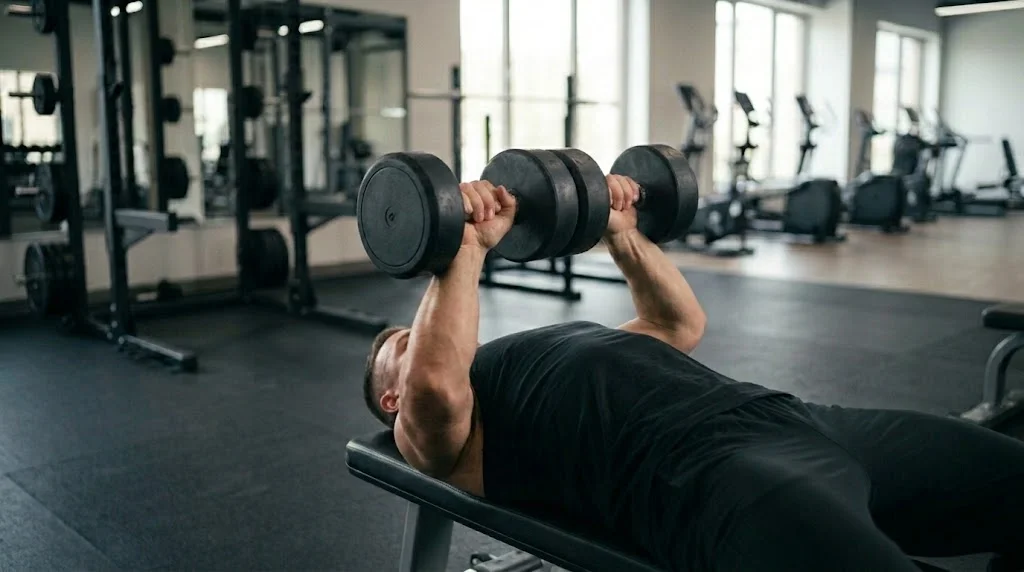
The dumbbell bench press twist is a flat-bench compound press in which the hands rotate from a palms-forward grip at the chest to a palms-back grip at lockout, training the chest. A standarddumbbell bench pressholds one grip the whole rep; here the rotation starts the moment the dumbbells leave the chest and finishes as the elbows straighten, so the elbows flare at the bottom and tuck at the top. The trade is load, since a rotating wrist cannot hold a heavy bell. Lifters use it as a second press on chest day.
What Muscles Does the Dumbbell Bench Press Twist Work?
- Primary: Pectoralis major (sternal and clavicular heads)
- Secondary: Anterior deltoid (front shoulder), triceps brachii
- Tertiary: Serratus anterior, rotator cuff, biceps brachii, wrist flexors
How Do You Set Up for the Dumbbell Bench Press Twist?
Sit on the end of a flat bench with a dumbbell on each thigh. Lie back and kick the dumbbells up so they sit over your chest, then plant your feet flat and wide with the glutes and upper back on the bench. Pull the shoulder blades down and together. Lower the dumbbells to the sides of your chest with the palms facing your feet and the elbows about 45 degrees out from the ribs.
How Do You Perform the Dumbbell Bench Press Twist?
- Set the dumbbells at the chest with the palms facing your feet, forearms vertical and the elbows flared to about 45 degrees.
- Press up and begin turning the hands inward as soon as the dumbbells leave the chest, letting the elbows drift toward the ribs.
- Pass through a neutral grip at mid-rep, with the palms facing each other and the dumbbells drawing together.
- Finish at lockout with the palms facing back toward your head and the inner plates almost touching over the lower chest.
- Squeeze the pecs for one second, then lower while turning the hands back the other way.
- Return to the palms-forward grip at the chest, elbows flared, and start the next rep from the stretch.
What Are the Key Form Cues?
- Turn as you press, not before: the rotation should take the whole concentric; if the hands are already palms-back at the chest, you are doing an underhand press.
- Elbows chase the ribs: let the rotation tuck the elbows on the way up so the upper arm turns in with the hands.
- Keep the shoulder blades pinned to the bench through both halves of the twist.
- Feel the pecs pull the dumbbells together at the top, as if finishing a fly.
- Unwind the hands on the way down at the same speed you wound them up.
What Are the Most Common Mistakes?
- Loading the dumbbells like a straight press: the wrists cannot rotate under the weight and the rep becomes a sloppy neutral press; use a weight you can turn smoothly every rep.
- Rotating at the top only: the press is over before the twist starts; begin turning the moment the bells leave the chest.
- Letting the shoulders roll forward at lockout: the shoulder blades lift off the bench and the front delt finishes the rep; keep the blades pinned and stop short of a full reach.
- Bouncing out of the bottom: the stretch reflex lifts the dumbbells and the flared position loads the shoulder capsule; pause for a beat at the chest.
- Clanking the dumbbells together: the plates take the finish and the pecs relax; stop them a finger's width apart.
What Are the Best Dumbbell Bench Press Twist Variations?
- Dumbbell bench press: one fixed pronated grip for heavier loading.
- Incline dumbbell bench press twist: a 30-degree incline points the finish at the upper chest.
- Dumbbell bench press underhand grip: the palms-back finish position held the whole rep.
- Alternating dumbbell twist press: one arm presses and rotates while the other holds at the chest.
- Cable twist press: a chest press from two low pulleys keeps tension at the top where dumbbells go light.
How Do You Progress the Dumbbell Bench Press Twist?
- Add 5 pounds a hand once every set reaches the top of the rep range with a full turn on every rep.
- Build from 8 reps a set to 12 before each weight jump.
- Add a fourth set when three no longer leave the chest fatigued.
- Lower on a three-count, or hold the palms-back lockout for two seconds.
How Should You Program the Dumbbell Bench Press Twist?
Place the dumbbell bench press twist after a barbell or heavy dumbbell press in a chest or push session, once or twice a week. Work 3 to 4 sets of 8 to 12 reps with 60 to 90 seconds of rest. It pairs with a cable fly, which trains the same finishing squeeze under constant tension. Keep the dumbbells light enough that the twist is complete on the last rep.