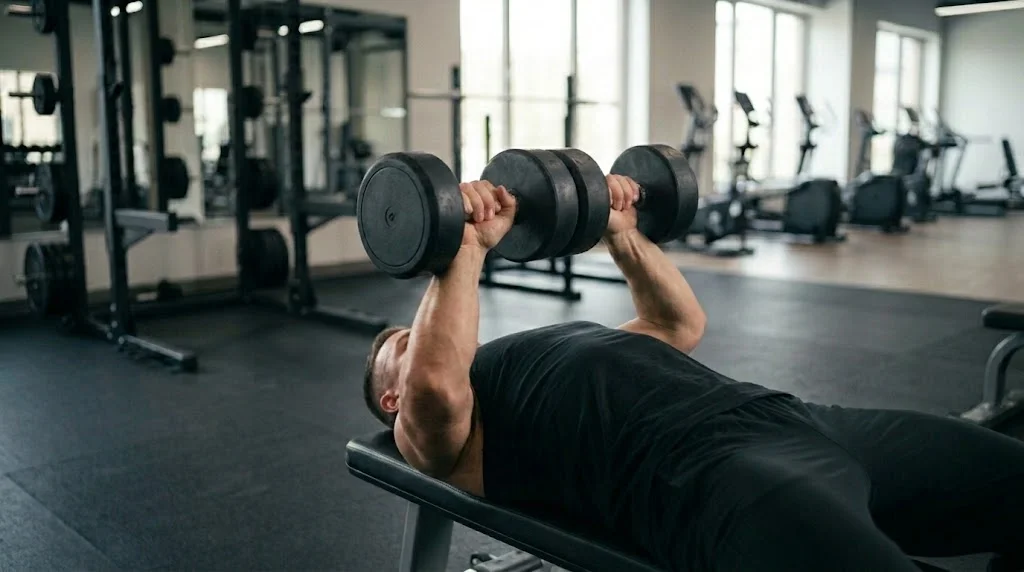
The standing dumbbell pressout is a horizontal press performed upright with two dumbbells squeezed together at the chest and pushed straight out to arm's length, training the frontshouldersand chest. Unlike a bench press, nothing supports your back, and the load is hardest at full reach, where the dumbbells sit furthest from the shoulder joint, so the weights stay light and the trunk resists being pulled forward. Pressing the two dumbbells into each other keeps the inner chest working the whole way out. Lifters program it as a warm-up or a late accessory in a push session.
What Muscles Does the Standing Dumbbell Pressout Work?
- Primary: Anterior deltoid (front shoulder), pectoralis major (inner chest)
- Secondary: Triceps brachii, serratus anterior
- Tertiary: Rectus abdominis, erector spinae, forearm flexors (grip)
How Do You Set Up for the Standing Dumbbell Pressout?
Take two light dumbbells and stand with the feet hip to shoulder width apart, knees soft. Hold the dumbbells against the middle of the chest with the palms facing each other, the flat faces of the plates pressed together and the elbows tucked below the hands. Pull the shoulders down and back, tuck the ribs, brace the trunk, and set the wrists straight so the dumbbells sit level.
How Do You Perform the Standing Dumbbell Pressout?
- Squeeze the dumbbells together hard enough that neither can slide, and keep that pressure on for the whole rep.
- Press the dumbbells straight out from the chest at shoulder height, the elbows extending along a line parallel to the floor.
- Reach full arm's length with the elbows straight but not snapped and the dumbbells still touching in front of the sternum.
- Hold for one count at full reach, feeling the front shoulders and inner chest take the load.
- Pull the dumbbells back slowly along the same line until the plates touch the chest again.
- Reset the ribs and shoulders, checking the trunk has not leaned back, before the next press.
What Are the Key Form Cues?
- Crush the plates together: the inward squeeze is the chest's job on this lift; lose it and the pressout becomes a pure front raise.
- Press level, not up: the dumbbells travel out at shoulder height, never drifting toward the ceiling as the arms straighten.
- Keep the ribs stacked over the hips as the weight moves away from you.
- Reach through the knuckles at the end, as if pushing the dumbbells through a wall.
- Return slower than you press so the shoulders control the weight coming home.
What Are the Most Common Mistakes?
- Grabbing your shoulder press dumbbells: the arms cannot reach full extension and the torso leans back to counterbalance; drop to a pair you can hold at arm's length for ten seconds.
- Leaning back as the arms straighten: the lower back arches and takes the load the shoulders should carry; brace the abs and keep the hips under the ribs.
- Letting the dumbbells separate on the way out: the squeeze disappears and the chest drops out of the lift; press the plates together before you move.
- Shrugging the shoulders up at full reach: the upper traps take over and the shoulder joint jams under the collarbone; keep the shoulders pulled down.
- Bending the wrists back under the load: the dumbbells tilt and the forearms take the strain; keep the wrists straight in line with the forearms.
What Are the Best Standing Dumbbell Pressout Variations?
- Seated dumbbell pressout: back support on a bench removes the trunk work, for lifters who lean back.
- Standing dumbbell pressout with hold: five seconds at full reach on every rep, for more shoulder time under load.
- Incline dumbbell pressout: the dumbbells travel out and up at 45 degrees, shifting the work to the upper chest.
- Single-arm dumbbell pressout: one dumbbell pushed straight out, a strong anti-rotation demand on the trunk.
- Standing goblet press out: one weight held by the horns, the same path with less inner chest squeeze.
How Do You Progress the Standing Dumbbell Pressout?
- Add 2.5 to 5 pounds per hand once you complete all sets at 15 reps with the arms fully straight at the end of every rep.
- Work from 10 reps up to 15 per set before adding weight.
- Add a set per week, from 2 up to 4.
- Extend the hold at full reach from one count to three, or slow the return to a three count.
How Should You Program the Standing Dumbbell Pressout?
Use the standing dumbbell pressout first in a push session as a light shoulder and chest warm-up, or last as an accessory after your bench and overhead pressing. Train it once or twice per week for 2 to 4 sets of 10 to 15 reps with 45 to 60 seconds of rest. Pair it with a face pull or band pull-apart so the rear shoulders balance the front.