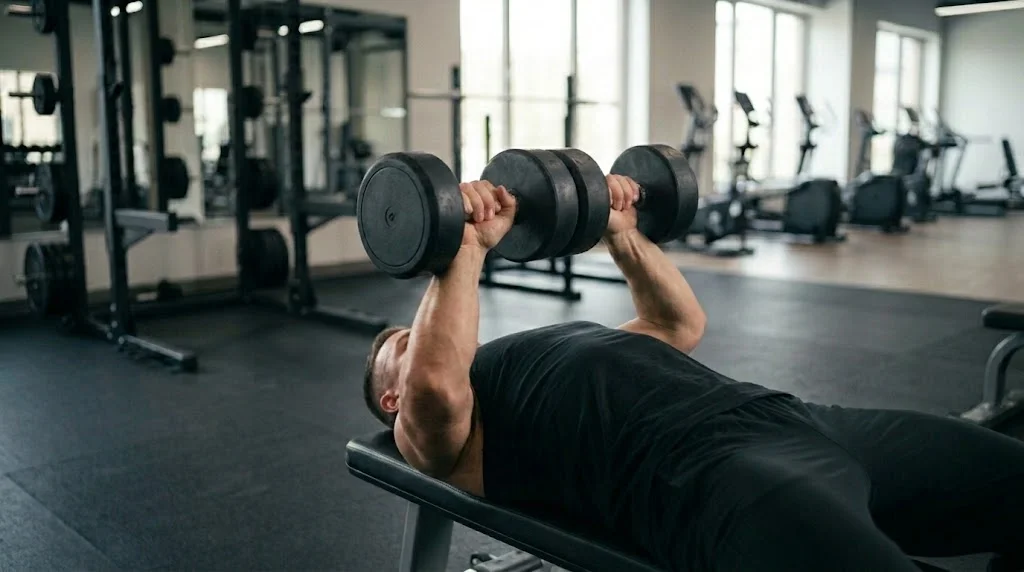
The incline dumbbell V raise is a shoulder isolation exercise performed seated against a 45-degree bench, lifting light dumbbells forward and outward in a V to train the front and side deltoids. The V path sits halfway between a front raise and a lateral raise, in the plane of the shoulder blade, so both heads share the load. Leaning back on the incline lets the arms start behind the torso, stretching the front delt before every rep, which a standing raise cannot do. Lifters program it late in a shoulder or push session, after presses.
What Muscles Does the Incline Dumbbell V Raise Work?
- Primary: Anterior and lateral deltoid (front and side shoulder)
- Secondary: Supraspinatus (rotator cuff), upper trapezius, serratus anterior
- Tertiary: Biceps brachii, forearm flexors, rectus abdominis
How Do You Set Up for the Incline Dumbbell V Raise?
Set an adjustable bench to about 45 degrees and sit with your back and head against the pad, feet flat and wide. Hold a light dumbbell in each hand with a neutral grip, thumbs up, and let the arms hang straight down beside the hips so the hands sit slightly behind the torso. Soften the elbows a few degrees, pull the shoulders down and away from the ears, and brace lightly.
How Do You Perform the Incline Dumbbell V Raise?
- Fix the elbow bend at a soft angle and turn the thumbs up so the dumbbells sit in line with the forearms.
- Raise both arms forward and outward at the same time, about 30 to 45 degrees outside straight ahead, so they trace a V.
- Stop at shoulder height when the dumbbells are level with the top of the bench pad and the arms form a wide V.
- Hold the top for one second, feeling the front and side delts tighten without the shoulders rising.
- Lower along the same lines slowly until the arms hang beside the hips and the front delts stretch.
- Let the dumbbells settle behind the torso for a moment, then start the next rep from the hang.
What Are the Key Form Cues?
- Thumbs lead the way: keep the thumbs up and slightly ahead of the dumbbells so the arm rises in the scapular plane, not as a front raise.
- Back stays glued to the pad: the moment the upper back peels off the bench, the torso is swinging the dumbbells up.
- Reach the dumbbells long and away from the body at the top, not up toward the ears.
- Keep the shoulders pulled down through the raise; the traps will try to shrug the weight up.
- Let the arms drift behind the torso at the bottom so every rep starts from a stretch.
What Are the Most Common Mistakes?
- Picking dumbbells you have to swing: the torso rocks forward off the pad and the hips help, so drop to a weight you can raise with the back pinned.
- Raising straight in front: the V collapses into a front raise, the side delt drops out and the front delt does everything, so open the arms to the 30 to 45 degree line.
- Shrugging the shoulders at the top: the upper traps lift the arms the last few inches and the delts stop working, so keep the shoulders down.
- Raising above shoulder height: driving the arms overhead with the shoulders behind the torso pushes the humeral head against the front of the socket, so stop at shoulder level.
- Bending the elbows more as fatigue sets in: the lever shortens and the load drops, so keep the arms long.
What Are the Best Incline Dumbbell V Raise Variations?
- Seated dumbbell front raise: upright, arms straight forward, an easier entry.
- Incline dumbbell Y raise: prone on the same bench, the arms rise into a Y and the rear delts take over.
- Standing dumbbell V raise: no back support, so the torso must hold itself still, a progression.
- Single-arm incline V raise: one dumbbell at a time, free hand on the thigh to keep the torso square.
- Incline cable V raise: two low pulleys keep the resistance constant from the bottom of the stretch to the top.
How Do You Progress the Incline Dumbbell V Raise?
- Add 2.5 to 5 pounds per hand once you complete all sets for 15 reps with the back on the pad.
- Build from 10 reps up to 15 before the next jump.
- Add a set at a time up to 4 sets.
- Pause for two counts at the top, or take three seconds to lower, when the next dumbbell is too big a jump.
How Should You Program the Incline Dumbbell V Raise?
Place the incline dumbbell V raise late in a shoulder or push session, after presses and after any heavydumbbell lateral raise. Train it 1 to 2 times per week for 3 to 4 sets of 10 to 15 reps, resting 45 to 60 seconds between sets. Pair it with a rear delt fly so the back of the shoulder gets the same attention as the front and side.