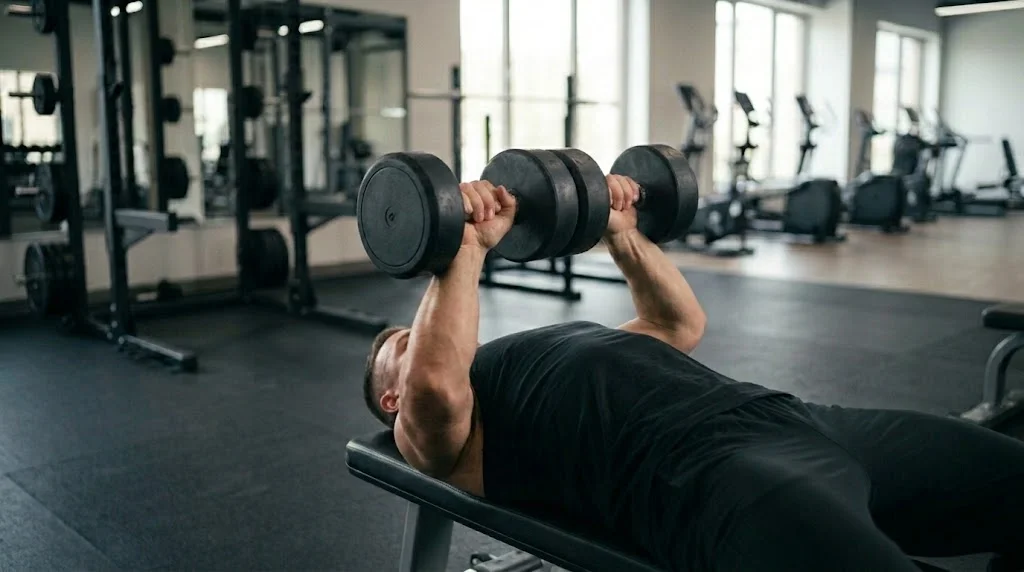
The dumbbell seated press with an alternating pronation grip is a shoulder-pressing exercise performed on a bench with back support, where the arms alternate pressing overhead while the wrists rotate from a neutral start into a pronated, palms-forward finish. Pressing one arm at a time increases core and trunk stability demands compared to pressing both arms together, while the grip rotation increasestricepsand shoulder involvement through the top of the range. It is a solid builder ofshoulder strengthand single-arm pressing control.
What Muscles Does This Exercise Work?
- Primary: Anterior and lateral deltoids
- Secondary: Triceps brachii, upper pectoralis
- Tertiary: Core and trunk stabilizers, upper trapezius
How Do You Set Up for This Exercise?
Sit on a bench with back support, feet flat on the floor. Hold a dumbbell in each hand at shoulder height with palms facing inward (neutral grip) and elbows slightly in front of your torso. Keep your back flat against the bench and core braced.
How Do You Perform This Exercise?
- Press one dumbbell straight overhead, rotating your wrist so your palm faces forward by the time your arm is fully extended
- Keep the opposite dumbbell stationary at the shoulder while the working arm presses
- Pause briefly at full extension overhead with the palm facing forward
- Lower the dumbbell under control, rotating the wrist back to neutral as it returns to shoulder height
- Immediately press the opposite arm using the same pronation rotation, alternating arms each repetition
- Keep your torso upright throughout, resisting the urge to lean or twist as one arm works
- Continue alternating for the desired number of total repetitions
What Are the Key Form Cues?
- Rotate on the way up: Begin the wrist rotation early in the press so the palm faces fully forward at lockout, not just at the very top
- Keep the resting arm locked at the shoulder: Don't let the stationary dumbbell drift or sag while the other arm presses
- Brace your core: A tight core keeps the torso from rotating or leaning toward the working side
- Press in a straight line: Avoid pressing the dumbbell forward over your face; keep it tracking over the shoulder
- Keep your back flat against the bench throughout to protect the lower back from excessive arching
What Are the Most Common Mistakes?
- Leaning or rotating the torso toward the pressing arm: This uses momentum instead of shoulder strength and can strain the lower back. Keep the trunk still and let the arm do the work.
- Rushing the grip rotation: Snapping the wrist at the top rather than rotating gradually reduces control and increases wrist strain. Rotate smoothly throughout the press.
- Flaring the elbow out too wide at the bottom: This places unnecessary stress on the shoulder joint. Keep the elbow roughly under the wrist as you begin each press.
- Excessive back arch: Arching to help drive the weight up shifts stress to the lumbar spine. Keep the lower back against the bench and use a lighter weight if arching is necessary to complete reps.
- Letting the resting dumbbell drop below shoulder height: This wastes the isometric hold benefit of the alternating pattern. Keep it parked at shoulder height between presses.
What Variations Are Worth Trying?
- Standard dumbbell shoulder press: Both arms press together with a neutral or pronated grip throughout, without the rotation
- Seated Arnold press: Uses the same rotating grip concept but presses both arms simultaneously
- Standing alternating dumbbell press: Removes the bench, adding core and lower-body stability demands
- Single-arm dumbbell press: Focuses on one side at a time for several sets before switching, useful for correcting imbalances
- Neutral-grip dumbbell press: Keeps palms facing inward throughout for a shoulder-friendly variation
How Do You Progress This Exercise?
- Increase weight gradually once you can complete all reps on both arms with a controlled rotation and no torso lean
- Add pause reps: Hold the top pronated position for 1-2 seconds to increase time under tension
- Increase reps to 12-15 per arm before adding significant weight
- Progress to a standing version once seated control and pressing strength are established
How Should You Program This Exercise?
Include this exercise in a shoulder or upper-body push session 1-2 times per week, performed for 8-12 reps per arm across 3 sets. Rest 60-90 seconds between sets. It works well as a primary or secondary shoulder-pressing movement, placed after compound pressing exercises like the barbell overhead press when using it as an accessory.