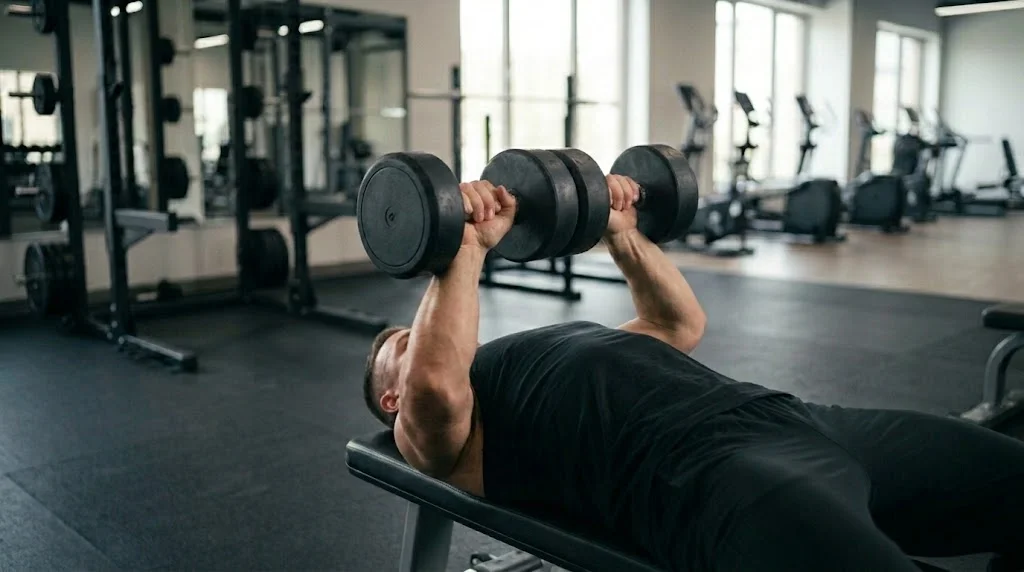
The standing dumbbell horizontal press is a chest exercise done upright with two dumbbells squeezed together at chest height and pressed forward, training the pecs and front delts. Standing, gravity pulls the dumbbells down rather than back toward you, so thechestonly works if you drive the dumbbells into each other for the whole rep while the front delts hold the arms level. That makes it a squeeze exercise for light dumbbells, not a strength press. Lifters use it as a chest warm-up or finisher when no bench is free.
What Muscles Does the Standing Dumbbell Horizontal Press Work?
- Primary: Pectoralis major (sternal and clavicular heads)
- Secondary: Anterior deltoid, triceps brachii, serratus anterior
- Tertiary: Rectus abdominis, spinal erectors, forearm flexors gripping the handles
How Do You Set Up for the Standing Dumbbell Horizontal Press?
Take two light dumbbells and stand with your feet hip width apart and knees soft. Hold the dumbbells in front of your sternum with the palms facing each other and the flat ends pressed together, elbows bent and pointing down and out. Brace your trunk, tuck your ribs, and pull your shoulders back and down so the chest is set before the elbows begin to straighten.
How Do You Perform the Standing Dumbbell Horizontal Press?
- Squeeze the dumbbells together hard enough that the plates cannot slide, with the elbows bent at chest height.
- Press straight forward at sternum height, extending the elbows while the dumbbells stay glued to each other.
- Stop just short of lockout when the arms are nearly straight and the dumbbells hang level with the shoulders.
- Hold the squeeze for one to two counts, pushing the dumbbells into each other so the inner chest tightens.
- Pull the dumbbells back toward the sternum over two counts, keeping them at the same height and still pressed together.
- Stop with the elbows bent and the dumbbells touching your chest, ribs still tucked, ready for the next rep.
What Are the Key Form Cues?
- Crush the dumbbells: The chest tension comes from the sideways squeeze, so keep pressing the plates into each other harder as the arms straighten.
- Press from the sternum, not the shoulders: Keep the path level with the lower chest so the front delts hold rather than lift.
- Imagine sliding the dumbbells along a table at chest height, never letting the path drop or rise.
- Keep the elbows pointing slightly down through the press so the pecs, not the traps, own the arc.
- Exhale through the lockout to keep the ribs down when the weight pulls forward.
What Are the Most Common Mistakes?
- Grabbing heavy dumbbells: Past a light pair the anterior delts fatigue before the chest and the reps turn into a jerky front raise. Use dumbbells you could hold at arm's length for a minute.
- Letting the dumbbells drift apart: Without the squeeze the pecs unload and the movement becomes a triceps extension. Keep the plates touching from start to finish.
- Leaning back to lock out: Rocking the torso adds a hip drive and shifts the line to the upper chest and shoulders. Keep the ribs stacked over the hips.
- Shrugging the shoulders as the arms extend: The upper traps take over and the shoulder blades ride up. Keep the shoulders pulled down before each rep.
- Dropping the elbows and pressing upward: Pressing at an incline turns it into a partial shoulder press. Keep the dumbbells level with the sternum.
What Are the Best Standing Dumbbell Horizontal Press Variations?
- Plate squeeze press: Two plates pressed together instead of dumbbells, thinner and easier to keep flat for beginners.
- Standing goblet press out: One dumbbell held vertically and pressed forward, adding a longer lever for the core.
- Single-arm standing dumbbell horizontal press: One dumbbell pressed forward against a wall or your other palm, loading each side separately.
- Incline dumbbell squeeze press: Lying on an incline bench with the dumbbells pressed together, letting gravity load the chest for heavier work.
- Cable chest press: A high cable pressed forward for constant horizontal resistance.
How Do You Progress the Standing Dumbbell Horizontal Press?
- Add 2.5 to 5 pounds per dumbbell once you complete every set at the top of the rep range with the plates never separating.
- Build from 12 reps to 20 per set before adding load.
- Add a fourth set when three sets no longer leave the chest pumped on the last reps.
- Lengthen the squeeze at extension to three counts, or slow the return to four counts, before adding weight.
How Should You Program the Standing Dumbbell Horizontal Press?
Use it as a chest warm-up before bench pressing or as the last chest movement of a push session, up to two times per week. Do 3 to 4 sets of 12 to 20 reps with 45 to 60 seconds of rest. It pairs well with a cable fly or push-up in a finisher and fills the chest slot when every bench is taken. Stop the set when the plates start to separate.