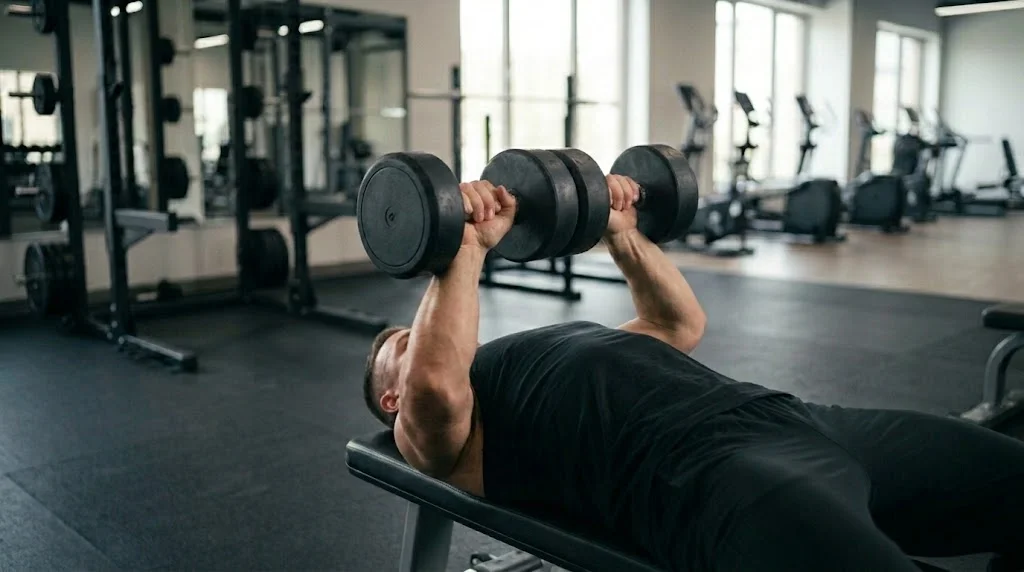
The chest kettlebell fly is a bench-supported isolation exercise that uses twokettlebellsto move the arms through a wide arcing motion, stretching and contracting thepectoral muscles. Lying flat with a kettlebell in each hand, the lifter lowers the weights out to the sides and brings them back together over the chest, keeping a fixed slight bend in the elbows throughout. The kettlebell's offset handle changes the grip and balance demands compared to a dumbbell fly, requiring extra wrist and forearm control.
What Muscles Does the Chest Kettlebell Fly Work?
- Primary: Pectoralis major (sternal and clavicular heads)
- Secondary: Anterior deltoids, pectoralis minor
- Tertiary: Biceps brachii, forearm and grip muscles
How Do You Set Up for the Chest Kettlebell Fly?
Lie flat on a bench with feet planted firmly on the floor. Hold a kettlebell in each hand with palms facing each other, arms extended directly above your shoulders and a slight, fixed bend in the elbows. Press your shoulder blades and lower back gently into the bench before beginning the movement.
How Do You Perform the Chest Kettlebell Fly?
- Brace your core and press your shoulders into the bench before lowering the weights
- Lower the kettlebells out to the sides in a wide arc, keeping the slight elbow bend fixed
- Continue lowering until you feel a deep stretch across the chest, roughly level with your shoulders
- Pause briefly at the bottom of the stretch without letting the shoulders roll forward
- Reverse the arc, driving the kettlebells back together above your chest using your pectoral muscles
- Squeeze your chest at the top without letting the kettlebells touch or clank together
- Repeat for the desired number of reps, controlling both the lowering and lifting phases
What Are the Key Form Cues?
- Fix the elbow bend: Keep a consistent slight bend throughout - don't straighten the arms like a press or bend them like a press-fly hybrid
- Move in an arc, not a straight line: The kettlebells should trace a wide semicircle, not travel straight up and down
- Keep shoulder blades pinned: Retract and depress the shoulder blades against the bench to protect the shoulder joint
- Lead with the wrists: Keep the wrists neutral and stacked over the kettlebell handle to avoid excess grip strain
- Control the descent: Lower the weights slowly rather than letting gravity and momentum drop them
What Are the Most Common Mistakes?
- Bending the elbows too much: Turning the fly into a press reduces the chest stretch and shifts work to the triceps and shoulders. Keep the elbow bend fixed and slight.
- Using too much weight: Overloading the fly forces the elbows to bend excessively and can strain the shoulder joint at the bottom of the stretch; use a moderate, controllable load.
- Lowering too far: Dropping the kettlebells below shoulder level places unnecessary stress on the anterior shoulder capsule. Stop the stretch roughly in line with the shoulders.
- Losing shoulder blade contact: Letting the shoulders roll forward off the bench during the stretch reduces stability and increases injury risk.
- Clanking the kettlebells together at the top: Banging the weights together indicates the chest isn't controlling the full range of motion; stop just short of contact and squeeze.
What Are the Best Chest Kettlebell Fly Variations?
- Dumbbell chest fly: More common equipment with a symmetrical, non-offset grip
- Incline kettlebell fly: Bench set to an incline to emphasize the upper chest
- Decline kettlebell fly: Bench set to a decline to emphasize the lower chest
- Single-arm kettlebell fly: Unilateral version that adds a core anti-rotation demand
- Cable or machine chest fly: Provides constant tension throughout the range of motion, unlike the free-weight version where tension drops near the top
How Do You Progress the Chest Kettlebell Fly?
- Increase weight gradually: Add small increments once you can complete all reps with a full, controlled stretch
- Slow the eccentric: Lower the kettlebells over 3-4 seconds to increase time under tension
- Add a pause at the stretch: Hold the bottom position for 1-2 seconds before reversing the movement
- Progress the bench angle: Rotate between flat, incline, and decline positions to develop the chest evenly
How Should You Program the Chest Kettlebell Fly?
Use the chest kettlebell fly as an isolation or finishing exercise after heavier compound pressing work, 1-2 times per week. Perform 10-15 reps for 2-4 sets with a moderate, controllable weight, resting 60-90 seconds between sets. Because it places significant stress on the shoulder joint at full stretch, prioritize strict form and a limited range over heavy loading.