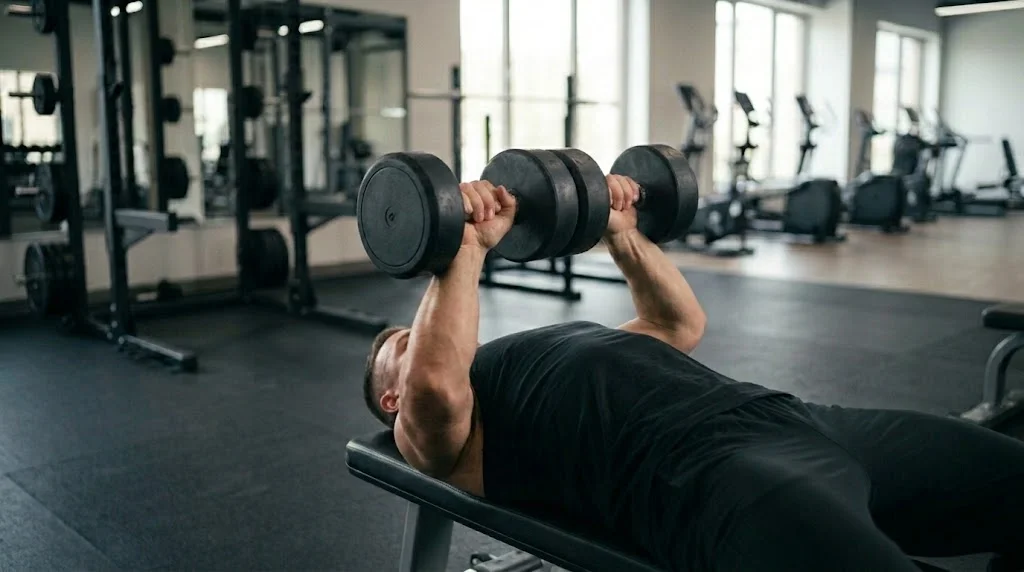
The kettlebell chest press is a horizontal press performed lying on a flat bench with one kettlebell held in both hands, pressing it over the sternum to train the chest and triceps. Both palms squeeze the same bell, so the hands push inward against each other the whole set and the inner chest stays contracted even at the bottom. The bench, unlike the floor, lets the elbows travel below your torso, so the pecs get a full stretch under that squeeze. It suits lifters with one bell and no rack.
What Muscles Does the Kettlebell Chest Press Work?
- Primary: Pectoralis major (chest), especially the inner fibres
- Secondary: Triceps brachii, anterior deltoid
- Tertiary: Serratus anterior, rotator cuff, forearm flexors (grip)
How Do You Set Up for the Kettlebell Chest Press?
Sit on the end of a flat bench with the bell on your thigh, both hands around the ball or the sides of the handle. Lie back and bring the bell onto your chest as you go, keeping it close. Plant your feet flat, hip width, press your shoulder blades into the bench and pull your ribs down. Push the bell up over your sternum until both elbows lock and your palms squeeze together.
How Do You Perform the Kettlebell Chest Press?
- Set the lockout with the bell over your sternum, elbows straight and both palms crushing it from the sides.
- Lower the bell toward your chest, bending the elbows and tucking them in toward your ribs.
- Touch the bell to your sternum with the elbows below the level of the bench, which marks the bottom.
- Hold for one count, squeezing the hands together so the chest stays loaded at full stretch.
- Press the bell back up in a straight line, driving the palms together as the elbows extend.
- Lock out and reset the squeeze and the brace, then lower into the next rep.
What Are the Key Form Cues?
- Crush the bell between your palms: press inward through the whole set so the chest works at both ends of the rep.
- Elbows toward your ribs: keep them tucked as the bell descends so the load stays on the chest, not the shoulder.
- Keep your shoulder blades pinned to the bench and your chest proud as the elbows drop below it.
- Drive the bell in a straight vertical line; there is no bar path to guide it, so watch the ceiling above your sternum.
- Keep both feet flat and heavy so the bench takes no rocking as the load moves.
What Are the Most Common Mistakes?
- Choosing a bell you cannot control with one grip: the ball drifts toward one hand and the press twists, so start light and only add size when the bell sits level.
- Letting the palms stop squeezing at the bottom: the bell slips down between your hands and the chest loses tension where it matters most.
- Bouncing the bell off the sternum: the ribs take the impact and the stretch reflex replaces the chest; touch lightly and pause.
- Flaring the elbows out level with the shoulders: this pins the joint in external rotation under load and stresses the front of the shoulder.
- Pressing the bell toward your face: the line drifts back over your throat, so keep it stacked above the sternum.
What Are the Best Kettlebell Chest Press Variations?
- Alternate kettlebell floor press: two bells on the floor, pressed one arm at a time.
- Single-arm kettlebell bench press: one bell racked on one forearm, adding a large anti-rotation demand.
- Incline kettlebell chest press: set the bench near 30 degrees to move load to the upper chest.
- Kettlebell floor press: the same press from the floor, which caps the depth at the upper arm.
- Dumbbell chest press: two dumbbells give a longer range and finer weight jumps.
How Do You Progress the Kettlebell Chest Press?
- Move up one kettlebell size, usually 4 kilograms, once every set finishes at the top of the rep range.
- Build from 8 reps to 15 before you change bells.
- Add a fourth set when three no longer fatigue the chest.
- Pause two seconds on the sternum, or lower on a four-count, before the next size increase.
How Should You Program the Kettlebell Chest Press?
Use the kettlebell chest press as the first press of achestday when a barbell is not available, or as an accessory after a bench press, one or two times a week. Work 3 to 4 sets of 8 to 15 reps with 60 to 90 seconds of rest. Pair it with a row or a fly so the pull matches the push and the chest gets work at a second angle.