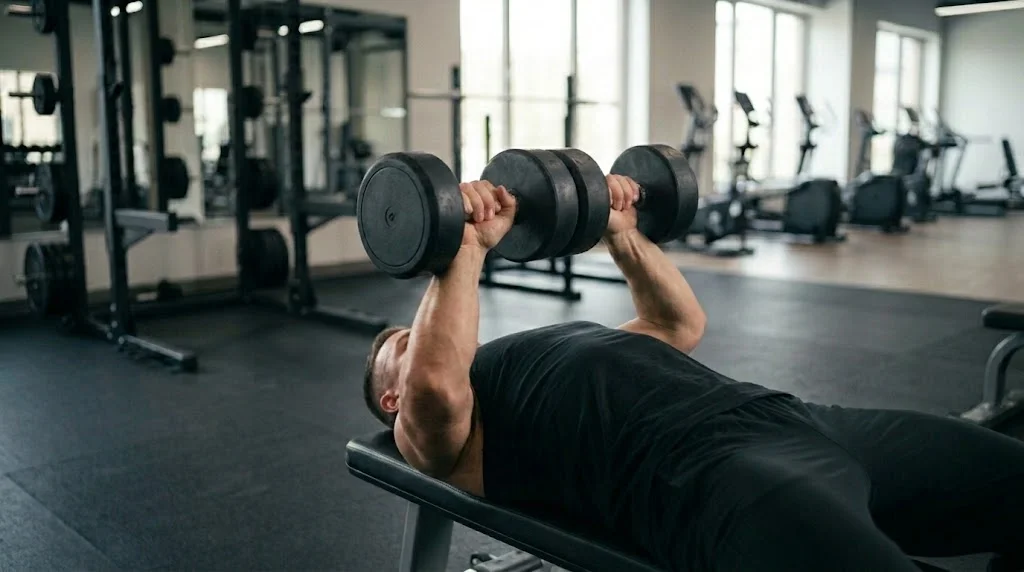
The dumbbell floor hex press is a chest press performed lying on the floor with two dumbbells squeezed together, the floor stopping the elbows level with the ribs. It is the floor version of thehex press, and the surface is the whole difference: the upper arms land on the ground, so the shoulder never reaches the stretched bottom position a bench allows, and the triceps get more of the second half. The inward squeeze on the dumbbells never lets up. It suits lifters training without a bench or working around a sore shoulder.
What Muscles Does the Dumbbell Floor Hex Press Work?
- Primary: Pectoralis major, sternal head (mid and inner chest)
- Secondary: Triceps brachii, anterior deltoid
- Tertiary: Serratus anterior, rectus abdominis, forearm flexors
How Do You Set Up for the Dumbbell Floor Hex Press?
Sit on the floor with a dumbbell beside each hip, knees bent and feet flat. Lie back, bringing the dumbbells onto your chest, and set your shoulder blades down and back against the floor. Turn your palms to face each other and press the flat sides of the dumbbells together over your sternum. Tuck the elbows to your ribs with the upper arms resting on the floor, wrists straight, and squeeze the dumbbells inward.
How Do You Perform the Dumbbell Floor Hex Press?
- Crush the dumbbells together over the sternum with the elbows tucked and the handles parallel.
- Press straight up, pushing the dumbbells into each other the whole way off the floor.
- Lock out over the lower chest with the arms straight and no gap showing between the dumbbells.
- Hold the top for one count, squeezing inward as hard as you can with the hips still down.
- Lower over two counts until both upper arms rest on the floor, dumbbells still touching.
- Let the triceps settle on the floor without unloading the squeeze, then press again.
What Are the Key Form Cues?
- Push the dumbbells into each other: press them together as if making one dumbbell, from the floor to lockout.
- Touch down, do not bounce: the upper arms meet the floor and stop there, so the chest holds the load at the bottom.
- Keep the forearms vertical so the press runs up rather than toward your face.
- Drive your heels into the floor to keep the trunk tight and the hips flat.
- Feel the inner chest tighten at the top instead of the triceps finishing alone.
What Are the Most Common Mistakes?
- Going too heavy: the dumbbells drift apart and the lift becomes a narrow floor press, so use a pair you can crush together on every rep.
- Bouncing the elbows off the floor: the rebound does the first inch of the press and the chest gets a rest it should not have, so touch and pause.
- Letting a gap open at lockout: the squeeze is the point of the movement and the pecs unload where it should peak, so stop an inch short if you cannot hold contact.
- Flaring the elbows on the descent: the dumbbells slide off each other and the front delt takes the load, so keep the arms beside the ribs.
- Arching the hips up to press: the lower back does the work and the range shortens, so keep the glutes and heels down.
What Are the Best Dumbbell Floor Hex Press Variations?
- Single-dumbbell floor press: one dumbbell held between both palms, the lightest way to learn the squeeze.
- Hex press: the same squeeze on a flat bench, where the elbows can travel below the chest.
- Feet-up floor hex press: knees bent over the hips, which takes the leg drive and the arch away.
- Single-arm floor press: one dumbbell at a time, the trunk resisting the twist toward the loaded side.
- Floor hex press with a bottom pause: three seconds resting on the floor before each press.
How Do You Progress the Dumbbell Floor Hex Press?
- Add 5 pounds a hand once every set hits the top of the rep range with no gap at lockout.
- Work from 10 reps up to 15 with the same pair before moving up.
- Add a fourth set once three no longer leave the chest fatigued.
- Pause three counts on the floor, or lower for a four-count, when the next pair is too heavy.
How Should You Program the Dumbbell Floor Hex Press?
Run the dumbbell floor hex press as your main press when you train without a bench, or second on a push day after a barbell or dumbbell bench press. Train it one to two times per week for 3 to 4 sets of 10 to 15 reps with 60 to 90 seconds of rest. Pair it with a push-up or a fly so the chest also works through the range the floor cuts off.