No Equipment Home Workout Plan
No dumbbells, no bands, no bar. Three sessions a week you can run in a hotel room, and a straight answer about what bodyweight training cannot do.
The week
Day 1
Pushing and upper back5 moves · 16 setsPush-ups on the floor if you can, hands on a chair or a windowsill if you cannot yet. Raising your hands is how you scale down, not dropping to your knees.
| Movement | Sets | Reps | Rest |
|---|---|---|---|
Push-Up: Classic Bodyweight Chest ExerciseStop each set two reps before your form breaks, not after. | 4 | 8-15 | 120s |
| 3 | 10-15 | 90s | |
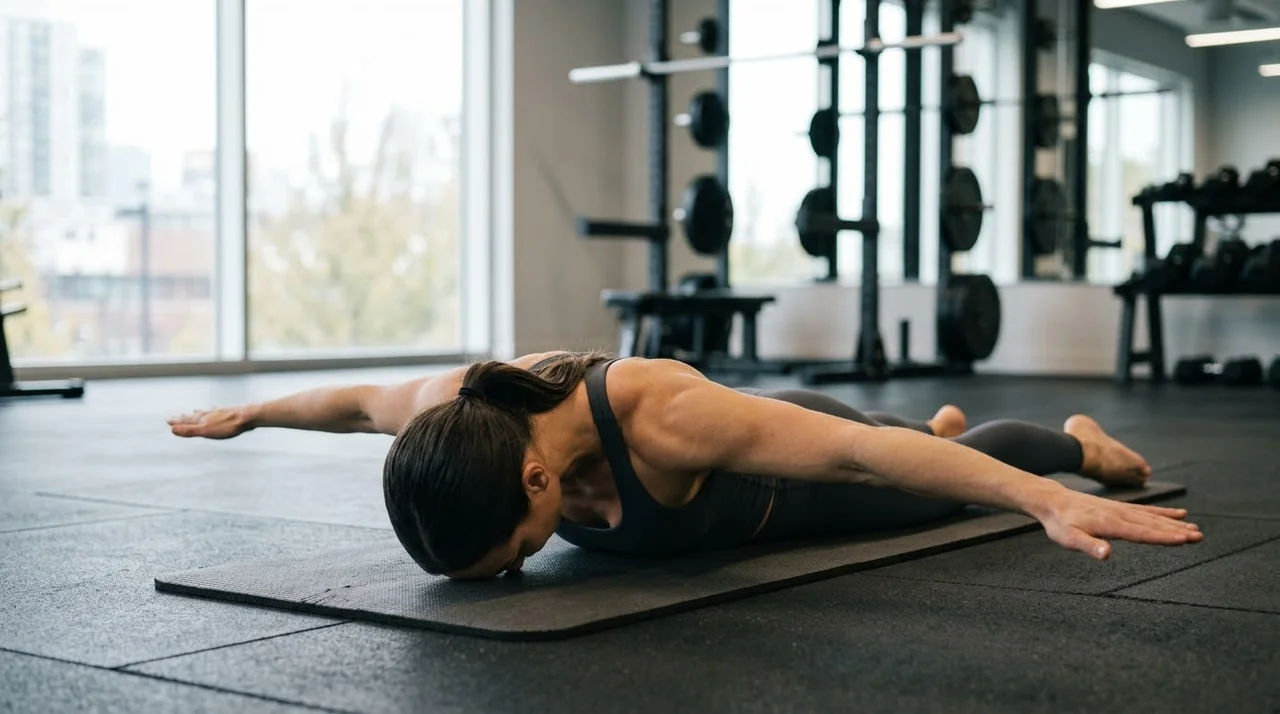 Reverse Snow AngelFace down, arms sweeping from your hips to overhead without touching the floor. The closest thing to a rear-delt row you get with no equipment. Reverse Snow AngelFace down, arms sweeping from your hips to overhead without touching the floor. The closest thing to a rear-delt row you get with no equipment. | 3 | 12-15 | 60s |
| 3 | 20-30s hold | 45s | |
| 3 | 10 each side | 45s |
Day 2
Legs5 moves · 16 setsBodyweight legs live or die on tempo and single-leg positions. Rushing a set of split squats is how you turn a leg session into cardio.
| Movement | Sets | Reps | Rest |
|---|---|---|---|
Bodyweight Split SquatThree seconds down. Back knee an inch off the floor, not resting on it. | 4 | 12 each leg | 90s |
| 3 | 45s hold | 60s | |
Duck WalkDeep squat position, small steps forward. Unpleasant, effective, and it costs nothing. | 3 | 30s | 60s |
| 3 | 20 total | 60s | |
| 3 | 12 | 45s |
Day 3
Core and conditioning6 moves · 19 setsShortest session of the three. Keep the rests honest and it still leaves a mark.
| Movement | Sets | Reps | Rest |
|---|---|---|---|
| 4 | 8 | 90s | |
| 3 | 12 | 60s | |
| 3 | 30s hold | 45s | |
Long-Lever PlankElbows further forward than a normal plank. Shorten the hold rather than letting your hips sag. | 3 | 30-45s hold | 45s |
| 3 | 20 | 45s | |
| 3 | 20-30s hold | 45s |
Weekly sets per muscle
Counted from the rows above, not typed in by hand. A movement that trains three muscle groups is counted for all three, so these add up to more than the 51 sets in the plan.
What this plan can and cannot do
Let's get the limitation out of the way, because most bodyweight plans won't.
Pushing works. Push-up variations scale from a wall to one arm, and that range covers years of progress for almost anyone. Legs work too, once you accept that single-leg positions and slow tempo are doing the job a barbell would.
Pulling does not work. You cannot train your lats without something to pull against, and there is no floor exercise that fixes it. Thereverse snow angeland the prone Y hold in Day 1 are here because they're the best available, and they train your rear delts and upper back rather than your lats. That's a partial answer and I'd rather say so than pretend.
If you can get one thing, get a pull-up bar.
Tempo is the load
With no way to add weight, the only variables left are how many reps, how many sets, and how long each rep takes. The third one is the most powerful and the least used.
Three seconds lowering on a split squat changes it completely. Twelve reps at that speed is about seventy seconds of continuous tension per leg, which is well past what your quads are used to. Do the same twelve reps in twenty seconds and you've done a warm-up.
Every hold in this plan works the same way. A wall squat for forty-five seconds isn't a stretch, it's a set.
Day by day
Day 1 is upper body: two push-up variations, two prone back movements, one core exercise. It's the session that most resembles a gym workout.
Day 2 is legs, and it's the one people underestimate.Duck walksfor thirty seconds at a time, in a deep squat, will make you reconsider what "no equipment" means about intensity.
Day 3 is short, forty minutes at most, and mixes core with conditioning. Burpees at the top while you're fresh, then holds and crunch variations.
Progression without numbers
The usual advice is to add reps, and it works right up until you're doing sets of thirty and the session takes ninety minutes.
Better order: add reps to the top of the range, then slow the tempo, then move to a harder variation of the same pattern, then add a set. Push-ups go floor, then feet on a chair, then wide stance, then archer. Split squats go bodyweight, then slow, then with your back foot up on a chair.
Write down which variation you're on and what the rep count was. That's your logbook, and it works exactly as well as a weight log.
How often, and what happens if you do this daily
Three sessions is the plan. Four or five a week is fine here, because the loads are low enough that recovery is rarely the limiter.
What doesn't work is the same session every day. Push-ups seven days a week for a fortnight and your wrists and elbows start filing complaints, and the complaint is legitimate. Rotate the three days and you can train most days of the week indefinitely.
Can you do this in a hotel room? All of it, in about two square metres. That's most of the reason it exists.
Scaling up and scaling down
Every movement here has a harder version and an easier one, and knowing both is what turns three sessions into a year of training.
Push-ups scale down to hands on a windowsill and up to feet on a chair, then to a wide stance, then to archer push-ups. Split squats scale down to a shorter range and up to a slow three-second descent, then to the back foot resting on a chair. Planks scale on time before they scale on position.
Write down which version you did and how many. A log of "push-ups, feet on chair, 4 x 12" is every bit as useful as a weight log, and it's the only way you'll notice that three months ago you were doing them on a windowsill.
The part nobody mentions about bodyweight training
It gets boring faster than weight training does.
With a barbell, the weight goes up and that's visible progress you can see on the bar. With bodyweight work, what changes? A variation every six weeks, which is far less obvious even when it's just as real.
So track it deliberately, and set a date to reassess. Eight weeks of these three sessions, done properly, will make a genuine difference to someone starting from nothing. It will do noticeably less for someone who's been training with weights for three years, and that's worth knowing before you start rather than after.
When to move on
Whenever you get access to equipment. That's not a failure of this plan, it's its purpose: keep training while you travel, while the gym is closed, while the budget is tight.
The day you have a pair of dumbbells, switch to thedumbbell only plan. The day you have a gym card, thethree day full body planis the natural next step. Everything you built here transfers.
Frequently Asked Questions
Can I build real muscle with no equipment at all?
Some, and then less and less. Pushing muscles do well because push-up variations scale a long way. Legs do reasonably well through single-leg work and tempo. Back and biceps stall early, because pulling your own body weight requires something to pull on, and nothing in a bare room provides it. That is not pessimism, it is the honest ceiling.
What single piece of equipment would fix the most?
A doorway pull-up bar, and it is not close. It costs about the price of two coffees a month for a year and it adds the entire pulling half of training that this plan cannot reach. A set of resistance bands is the second choice and the better one if doorframes are not an option.
How do I make push-ups harder once fifteen reps is easy?
Raise your feet onto a chair, then slow the lowering phase to four seconds, then move to a wide stance, then to archer push-ups where one arm takes most of the load. Each of those steps buys you months. Adding reps past twenty is the least useful direction.
Is three days a week enough with bodyweight training?
For a beginner, yes, and you can run these sessions more often than a weights program because the loads are lower. Four or five days a week is fine here. What you should not do is repeat Day 1 daily; push-ups every day for a fortnight is how wrists and elbows start complaining.
3 sessions a week