
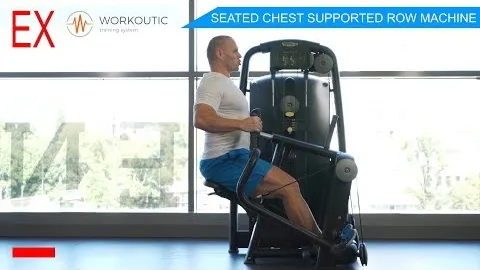
The seated chest supported row machine is an excellent exercise for targeting the muscles of the upper back and middle back. By using a machine that provides stable support, you are able to isolate the target muscles and effectively work them without the risk of straining other parts of your body. In this guide, we will walk you through proper form, muscle activation, and alternative variations to help you get the most out of this exercise.
Adjust the machine: Start by adjusting the seat height and chest support pad to a position that enables your upper chest to rest comfortably against the pad, while keeping your feet flat on the floor. Proper alignment is crucial for optimal results and injury prevention.
Grip the handles: Grasp the handles with an overhand grip, slightly wider than shoulder-width apart. Keep your elbows straight and avoid locking them out. Your palms should be facing down towards the floor.
Initiate the movement: Start by retracting your shoulder blades, pulling them back and down towards your spine. This will help to activate the muscles in your upper back before you begin the exercise.
Pull and squeeze: With your core engaged and your chest firmly pressed against the pad, initiate the rowing movement by pulling the handles towards your body. Focus on squeezing your shoulder blades together at the top of the movement to maximize muscle activation.
Controlled release: Slowly release the tension in your muscles as you extend your arms back to the starting position. Avoid jerking or using momentum to complete the exercise. The key is to maintain control throughout the entire range of motion.
The seated chest supported row machine primarily targets the following muscles:
Rhomboids: These muscles, located between the shoulder blades, are responsible for retracting and stabilizing the scapulae during the rowing movement.
Trapezius: The traps, particularly the middle portion, assist in retracting the scapulae and in the overall pulling motion of the exercise.
Latissimus dorsi: The lats are the largest muscles in the back and play a significant role in the rowing movement. They help to pull the handles towards the body and provide stability to the shoulders.
Posterior deltoids: The rear deltoids are activated during the rowing motion to assist the lats in pulling the handles towards the body.
By properly engaging these muscles, you can develop a strong and well-defined back, improve posture, and reduce the risk of shoulder injuries.
Single-arm row: Instead of using both arms simultaneously, perform the exercise with one arm at a time. This variation helps to identify and correct strength imbalances between the sides of your body.
Wide grip row: Adjust the grip on the handles to a wider position, placing more emphasis on the muscles of the upper back and outer portions of the lats.
Underhand grip row: Switch the grip on the handles to an underhand position (palms facing up). This variation targets the lower lats and biceps to a greater extent.
Bilateral row: Instead of using the machine, perform the same rowing motion with free weights or resistance bands. This variation adds an element of instability, engaging more stabilizing muscles throughout the body.
The seated chest supported row machine is a highly effective exercise for strengthening and developing the muscles of the upper and middle back. By following proper form, focusing on muscle activation, and incorporating alternative variations, you can maximize the benefits of this exercise and achieve greater overall back strength and stability. Remember to consult with a fitness professional or trainer if you are new to this exercise or have any pre-existing conditions that may affect your ability to perform it safely.
If you're looking for a gym, fitness club or yoga studio, you've come to the right place.
You can find information about gyms in your area. Browse catalog of gyms and find gyms with classes which are you looking for.
On gym page you can find simple information like address, phone or website. You can find list of available classes. You can check availability of personal training or small group classes. On place page you can also see information about open hours.
You can find gyms near you with amenities, courts, studios and equipments.
Use our map to find gym at your city or district.
In Gym Navigator you can find list of exercises with movies for many body parts.
You can browse exercises catalog and find exercises the best of you.
You can also find exercises grouped into workout plans, which you can use to improve you body. Each routine show you exercises one by one and give you possibility to count you progress and count down rest time.