Workout Plan to Build Muscle
Four sessions, every muscle trained twice a week, about eleven hard sets for the big ones. Built from the research on volume and frequency, and honest about where that research runs out.
The week
Torso A
Chest, back and shoulders, heavier5 moves · 17 setsThe heavy half of the week for the upper body. Take the first two lifts seriously, then let the shoulder work be quick and light.
| Movement | Sets | Reps | Rest |
|---|---|---|---|
Dumbbell Bench Press: Chest Strength & StabilityYour top set of the week for chest. Add weight only once every set reaches ten. | 4 | 6-10 | 150s |
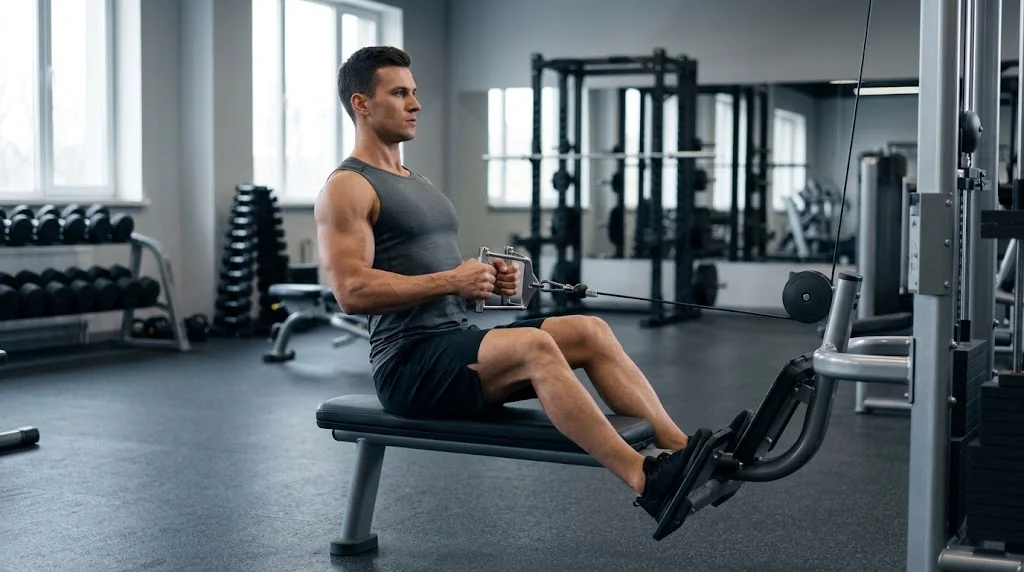 Seated Cable Row WorkoutChest up, pull to the lower ribs, pause for a beat before letting go. | 4 | 8-10 | 120s |
| 3 | 8-10 | 120s | |
| 3 | 10-12 | 90s | |
Dumbbell Lateral Raise: Side Delt IsolationLight and strict. If you're swinging the weight, it's too heavy. | 3 | 12-15 | 60s |
Limbs A
Quads, hamstrings, calves and arms, heavier6 moves · 20 setsLegs first while you're fresh, arms last. Skip the arm work before you skip a leg set.
| Movement | Sets | Reps | Rest |
|---|---|---|---|
V-Squat MachineFull depth you can control. Pausing for a second at the bottom costs nothing. | 4 | 8-12 | 150s |
| 3 | 8-10 | 120s | |
| 3 | 12-15 | 90s | |
| 4 | 12-15 | 60s | |
| 3 | 8-12 | 75s | |
| 3 | 8-12 | 75s |
Torso B
Chest, back and shoulders, higher reps6 moves · 20 setsSame muscles as Torso A, lighter loads and more reps. Machines and cables here are a feature: they let you push sets close to your limit without a spotter.
| Movement | Sets | Reps | Rest |
|---|---|---|---|
| 4 | 10-12 | 90s | |
| 4 | 10-12 | 90s | |
| 3 | 10-12 | 90s | |
| 3 | 12-15 | 60s | |
| 3 | 12-15 | 60s | |
Face Pull: Rear Delts & Upper Back HealthPull to your forehead, elbows high. Treat it as back work, not a warm-up. | 3 | 15-20 | 60s |
Limbs B
Quads, hamstrings, calves and arms, higher reps6 moves · 20 setsSingle-leg work first, because it's the exercise people skip when they're tired.
| Movement | Sets | Reps | Rest |
|---|---|---|---|
Dumbbell Bulgarian Split Squat: Single-Leg StrengthHold the dumbbells at your sides. Add reps before you add weight. | 4 | 8-10 each leg | 120s |
| 3 | 10-12 | 120s | |
| 3 | 10 each leg | 90s | |
| 4 | 12-15 | 60s | |
| 3 | 10-12 | 75s | |
| 3 | 10-12 | 75s |
Weekly sets per muscle
Counted from the rows above, not typed in by hand. A movement that trains three muscle groups is counted for all three, so these add up to more than the 77 sets in the plan.
Why Split Training Into Torso and Limbs?
Training a muscle twice a week beats training it once. A 2016 meta-analysis of studies that matched total volume found exactly that, with a larger hypertrophy effect size at the higher frequency (0.49 against 0.30). Whether three times beats twice is still unsettled, so I haven't pretended otherwise.
A torso and limbs split gets you the twice-a-week frequency in four days. Torso days take everything that presses and pulls. Limb days take legs and arms. It differs from theupper lower splitmainly in where the arms live, and it spares your triceps from a pressing session on the same day.
Three days a week is the better start if you're new. The3 day full body plancovers that, and thepush pull legs planis the next step up in volume.
How Many Sets Do You Really Need?
Here's what the data says. A 2017 meta-analysis of 15 studies found a graded dose-response: each extra weekly set was linked to roughly 0.37 percent more muscle growth. A 2026 meta-regression of 67 studies confirmed that gains rise with volume, and also that the returns diminish.
Neither paper hands you a magic number. That's why this plan lands in the middle: about 11 sets a week for chest, back and quads, 9 for hamstrings and glutes, 8 for calves and 6 direct sets each for biceps and triceps. Pressing and rowing hit the arms as well. The muscle bars on this page count every muscle an exercise is tagged with, so they'll read higher than my numbers.
What Reps, Load and Rest Should You Use?
The ACSM position stand on progression recommends loads in the 1 to 12 repetition maximum range for hypertrophy, with emphasis on 6 to 12 and rests of one to two minutes. This plan stays in that window.
Heavy isn't the only route. A 2017 meta-analysis found muscle growth was similar across a wide spread of loads when sets were taken to failure. Strength favoured the heavy end. So Torso A and Limbs A go heavier and Torso B and Limbs B go lighter.
Rest longer than feels necessary on the big lifts. In one 8-week study of 21 trained men, three-minute rests built more thigh muscle than one-minute rests. It's a small trial, which is why I've settled on two to two and a half minutes rather than three.
How Do You Progress on This Plan?
Double progression is the simplest version. Work in the rep range, and once every set reaches the top, add the smallest weight jump your gym has. ACSM's own wording suggests adding 2 to 10 percent once you can do one or two reps over the target.
Will you grow without ever training to failure? Probably yes. A 2023 meta-analysis found no evidence that failure beats stopping short. I'd rather you finish most sets with a rep in hand and show up fresh on Thursday.
What Should You Eat to Build Muscle?
Training sets the signal and food supplies the material. In a 49-study meta-analysis, extra protein stopped adding to gains in fat-free mass at about 1.6 grams per kilogram of body weight a day. Aim near that and spend the rest of your attention on sleep.
How Do the Four Days Fit Into a Week?
Monday Torso A, Tuesday Limbs A, Thursday Torso B, Friday Limbs B. Wednesday and the weekend are rest. The heavy pair opens the week and the lighter pair closes it. Back-to-back days are fine here, because each day trains different muscles from the one before.
Can you only train three days some weeks? Run the four sessions in order and pick up where you stopped, so the rotation rolls on instead of resetting. Frequency drops to about one and a half sessions per muscle, which is a step down from the research-backed twice, but it beats skipping the week.
How Should You Warm Up and Swap Exercises?
Before the first lift of each day, do two lighter ramp-up sets: about half your working weight for eight reps, then roughly three quarters for four. After that, no more warm-up sets.
If your gym lacks the V-squat machine or the supported row, swap in a movement that trains the same muscle in the same direction and keep the rep range. Theexercise libraryfilters by equipment and muscle.
Where Is This Plan Thin?
Abs get no direct work, and neither do forearms. If you want abs, add two hard sets of theslow bicycle crunchat the end of either limbs day. Hamstrings and glutes sit at 9 sets, a little lower than the other big muscles, so I'd add a set to the stiff-leg deadlift first if they lag.
Who Should See a Doctor First?
This is general information, not medical advice. If you have a heart condition, high blood pressure, an injury or any pain with exercise, see a doctor before starting. Stop a set if something feels sharp.
Where Do the Numbers Come From?
I built this plan from published research rather than from a coaching practice:Schoenfeld et al. on frequency, 2016,Schoenfeld et al. on weekly volume, 2017,Pelland et al., 2026,ACSM progression models, 2009,Schoenfeld et al. on load, 2017,Schoenfeld et al. on rest, 2016,Refalo et al., 2023andMorton et al., 2018.
Frequently Asked Questions
How many sets per muscle do I need each week?
More sets bring more growth, up to a point. A 2017 meta-analysis found each extra weekly set was linked to about 0.37 percent more muscle gain. A 2026 meta-regression found gains keep rising with volume but with diminishing returns. This plan sits between 6 and 15 hard sets per muscle depending on the muscle, which is a sensible middle, not a proven optimum.
Do I have to train to failure?
No. A 2023 meta-analysis found no evidence that training to momentary failure builds more muscle than stopping short of it. Finishing most sets with a rep or two in reserve keeps the next session usable, and that matters more than squeezing out one extra rep.
How much protein should I eat?
A 2018 meta-analysis found that gains from protein stopped increasing at a total intake of around 1.6 grams per kilogram of body weight per day. For a 75 kg person that is roughly 120 grams. It's an average from group data, so treat it as a target to aim at, not a hard line.
Can a beginner run this plan?
A true beginner will do better on three full-body days first. The ACSM position stand on resistance training suggests 2 to 3 days a week for novices and 3 to 4 for intermediates, and four sessions of twenty sets is a lot to recover from in your first months.
4 sessions a week